

Ingredient Management System
Ingredient Management System — Identity, Quality, Allergen & Inventory Control From Intake to Batch
This topic is part of the SG Systems Global regulatory & operations glossary.
Updated November 2025 • ingredient management system, ingredient master data, lot & supplier control, allergens, FEFO, COAs, inventory & batching integration • Food Processing, Sausage & Meat, Bakery, Dietary Supplements, Pharma, Cosmetics, Ingredients & Dry Mixes, Agricultural Chemicals, Consumer Products
An enterprise-grade Ingredient Management System is the backbone that keeps every raw material in your plant under control—from supplier and COA to lot, allergen, storage location, weighing, consumption and traceability. It connects the ingredient master (what it is, how it should be handled) with the operational reality (what lot you actually received, where you put it, what batches it went into, what results it produced).
Spreadsheets and basic ERP item lists can tell you “we buy sugar.” A real Ingredient Management System can tell you: “We have supplier lot X from vendor Y, in bins B-03 and B-04, released by QA yesterday, used in batches A123–A128, under these recipes, with these yields and no open deviations.”
“If you can’t answer which ingredient, which lot, which supplier, which COA, which bin, which batch and which customer—without hunting through manuals and spreadsheets—you don’t have ingredient management. You have ingredients in the building.”
TL;DR: An Ingredient Management System manages the full lifecycle of raw materials and components:
- Keeps a controlled ingredient master with UoM, allergens, specs, hazards and vendors.
- Tracks lots, expiry, QA status and FEFO from goods receipt to bin.
- Integrates with weigh & dispense automation, batching systems and MES for controlled usage.
- Feeds lot-level inventory and genealogy into WMS, LIMS, QMS and ERP/QuickBooks.
- Supports GFSI, GMP and regulatory frameworks (21 CFR 111/117/211, ISO 22716, BRCGS, SQF) by providing clean, auditable ingredient data.
1) Why you need an Ingredient Management System—hard truths
- Ingredients are where most risk enters the plant. Allergens, contaminants, mis-labelled materials and potency variability all come through raw materials first.
- “Item = ingredient” is too simplistic. The same “item” can be sourced from multiple suppliers, plants, countries, specs and potency bands. Those differences matter in quality and compliance.
- Multi-site and co-manufacturing add complexity. An ingredient that is fine in Plant A may not be qualified for Plant B or a particular product or market. The system must know that.
- Cost and yield depend on how ingredients are used, not just purchased. Overscaling, substitutions and rework all distort real COGS if they are not tracked at ingredient level.
- Traceability begins at the dock, not at the batch record. If you don’t manage ingredient identity, status and history correctly from intake, downstream genealogy will always be fragile.
2) Scope of an Ingredient Management System
| Area | What it controls | Glossary anchors |
|---|---|---|
| Ingredient Master Data | Code, name, description, UoM, density, allergens, hazards, spec links | UoM Conversion, Allergens |
| Specifications & COAs | Target/limit values, test methods, COA requirements, sampling plans | Specification Management, CoA |
| Supplier & Vendor Control | Approved suppliers, vendor lots, vendor qualification and risk | Supplier Quality Management (SQM) |
| Receiving & Lot Creation | Goods receipt, lot IDs, expiry, QA hold/release, intake labelling | Goods Receipt, Hold/Release |
| Storage & Zoning | Bin locations, temperature zones, allergen / hazard segregation | Warehouse Locations & Zones, Allergen Control Program |
| FEFO/FIFO Rules | Rotation by expiry or receipt date, per ingredient or ingredient group | FEFO, FIFO |
| Weighing & Consumption | Controlled weighing, tolerance bands, per-batch usage and rework | Weigh & Dispense Automation, Batch Weighing |
| Inventory & Replenishment | On-hand per lot and bin, par levels, re-order points and planning | Inventory Accuracy, Par Level Management |
| Traceability & Genealogy | Which batches and customers used each ingredient lot | Lot Traceability, Batch Genealogy |
| Data Integrity & Audit | User roles, approvals, audit trails, record retention | Data Integrity, Audit Trail (GxP) |
| Integrations | ERP/QuickBooks, MES, WMS, LIMS, QMS, PLM, label systems | MES, WMS, LIMS |
3) Ingredient master data—where control starts
The ingredient master is more than a list of codes. It should include:
- Identity. Ingredient code, common and technical names, category (e.g., macro, micro, API, excipient, fragrance, packaging component).
- UoM and conversion. Base UoM (kg, L, lb), purchasing UoM (bag, drum, tote), and UoM conversion factors.
- Allergen and hazard attributes. Food allergens, sensitizers, solvents, flammability, corrosivity, etc., tied into zoning and labelling rules.
- Specifications & test methods. Target and limit values, required tests, and reference to specification management records.
- Supplier mappings. Approved suppliers, typical origins and supplier-specific codes.
An Ingredient Management System keeps this master under Document Control, so labels, recipes, ERP and shop floor are all referring to the same ingredient definitions.
4) Supplier control, specifications & COAs
Ingredients differ by supplier even when item codes don’t. The system must handle:
- Supplier qualification. Approved vs provisional suppliers, audit status, SCAR history, managed under Supplier Quality Management.
- Spec variants. Slightly different specs per supplier or origin (e.g. flour protein bands, vitamin potency ranges) with clear mapping to recipes.
- COA management. COAs flagged as required/optional, matched to lots at receipt, with exceptions kicking off QA holds or deviations.
- Sampling plans. Built-in rules for when and how lots are sampled and tested, tied to risk and regulatory requirements.
5) Receiving, lot creation & first status
At goods-in, the Ingredient Management System creates or registers lots and sets the first status:
- Lot IDs. Internal lot numbers linked to supplier lots, POs, dates and receipts.
- Status by default. New lots land in quarantine, pending COA check and/or LIMS results; use is blocked in WMS and MES until Hold/Release rules are satisfied.
- Labelling. Intake labels use barcodes (often GS1-128), encoding item, lot, UoM, quantity and expiry.
- Conditions. Temperature or other condition checks stored with the lot for shelf-life and quality analysis.
6) Storage, FEFO & zoning—where ingredients live between receipt and batch
Once released, the system must ensure ingredients are stored and rotated correctly:
- Bin assignments. Warehouse locations define where chilled, frozen, ambient, flammable or allergen-bearing ingredients can be stored.
- FEFO and FIFO rules. FEFO rules ensure near-expiry lots are used first; FIFO handles stable ingredients or packaging.
- Allergen and hazard segregation. Allergen-, high-potency-, fragrance- or hazard-bearing ingredients may require dedicated zones, racks or cabinets; the system enforces these rules at put-away and transfer.
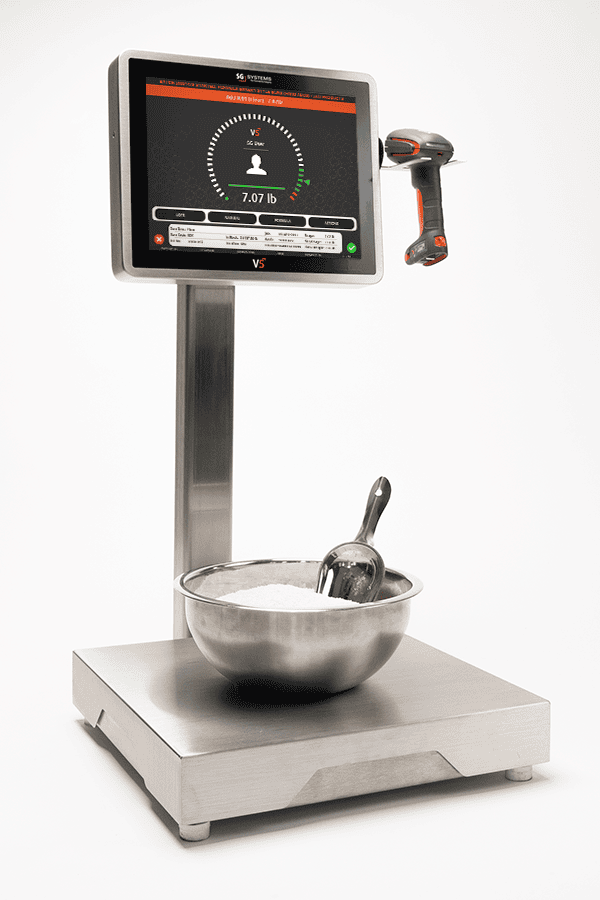
7) Weighing, dispensing & usage—where ingredients meet recipes
The weigh room and batching areas are where ingredients turn into risk or value:
- Barcode-controlled selection. Operators scan ingredient labels; the system verifies item, lot and status before allowing a weigh & dispense step.
- Per-ingredient tolerances. Tolerances and weighing logic come from recipe and spec, not operator memory.
- Real consumption vs plan. Actual weights and usage by lot feed back into the Ingredient Management System for inventory, costing and genealogy.
- Rework tracking. Rework lots are treated as ingredients with their own properties, limits and status, tracked through usage like any other component.
8) Ingredient inventory & replenishment
Accurate ingredient inventory is crucial for both production planning and cash:
- On-hand by lot and bin. The system always knows how much of each lot is where—including silos, totes and line-side staging areas.
- Par levels and mins/maxes. Par level management flags when to reorder or transfer ingredients based on usage and lead time.
- Vendor and lot performance. Consumption and reject data by supplier and lot support better purchasing and negotiation.
9) Traceability, recalls & ingredient-driven investigations
When something goes wrong, questions usually start with an ingredient:
- Trace-back. From a finished lot or complaint, you can see which ingredient lots it used, from which suppliers, and through which batches.
- Trace-forward. From a suspect ingredient lot or supplier, you can see all batches, products and customers affected, and how much remains in stock.
- Mock recalls. The Ingredient Management System supports mock recall performance by providing reliable, fast answers, not reconstructions.
10) How V5 provides an Ingredient Management System across MES, WMS & QMS
V5 Traceability delivers ingredient management as a cross-platform capability:
- Ingredient master & specs. Items, UoMs, allergens, specs and supplier mappings can be managed in V5 or synchronised from ERP, then used across all V5 modules.
- Receiving & lot status in V5 WMS. V5 WMS handles lot creation, intake labels, put-away, bins, FEFO and status control.
- Weigh & dispense in V5 MES. V5 MES uses the ingredient master and lot data to enforce recipe-driven weighing and consumption with full genealogy.
- QA & COA linkage in V5 QMS. V5 QMS manages specs, COA checks, supplier audits, deviations and CAPA related to ingredients.
- Integration via V5 Connect API. The V5 Connect API ties V5 to ERP/QuickBooks, PLM, LIMS and label systems, so ingredient data flows across your landscape.
11) KPIs that show your Ingredient Management System is working
- Ingredient master completeness: % of active ingredients with fully defined specs, allergens, suppliers and UoM conversions.
- Lot status discipline: number of incidents where quarantined or expired ingredient lots were picked or used (target: zero).
- Inventory accuracy for key ingredients: system vs physical counts for high-value or high-risk ingredients.
- COA/inspection match rate: % of lots with COAs and required tests completed before release.
- Recall response time: time to identify all batches and customers impacted by a suspect ingredient lot.
- Supplier performance trends: deviations, rejections and complaint linkages by supplier over time.
12) Common pitfalls in ingredient management
- Treating ingredients as “just items.” No distinction between suppliers, potency bands or specs leads to hidden variability and risk.
- Spreadsheet-driven master data. Ingredient attributes live in uncontrolled spreadsheets rather than a single governed system.
- No status enforcement. QA holds and expiries are tracked on paper or in LIMS, but not enforced by WMS or MES at point-of-use.
- Untracked substitutions. Operators swap similar ingredients without recording the change; genealogy and claims become questionable.
- Partial integration. Ingredient data is not joined up across ERP, MES, WMS, LIMS and QMS, forcing manual reconciliations.
13) Quick-start checklist for an Ingredient Management System
- Inventory current ingredient masters: identify duplicates, missing allergens, inconsistent UoMs and weak specs.
- Establish a single governed ingredient master (V5 + ERP/PLM) and migrate core ingredients into it.
- Introduce lot-based receiving and status control for high-risk ingredients (allergens, actives, micro-sensitive).
- Integrate ingredient lots into weigh & dispense and MES so consumption is properly recorded and enforced.
- Run an ingredient-centred mock recall: pick an ingredient lot and trace it from receipt to batches and customers using only system data.
14) FAQ — Ingredient Management System
Q1. How is an Ingredient Management System different from a generic inventory system?
A generic inventory system tracks item quantities and locations. An Ingredient Management System adds ingredient-specific data (allergens, specs, suppliers, COAs), status control, integration with weighing and recipes, and lot-level traceability end-to-end.
Q2. Do I need a dedicated Ingredient Management System if I have ERP?
Most ERPs provide basic item and lot functions but lack tight integration with weigh & dispense, MES execution, LIMS and QMS. An Ingredient Management System like V5 can sit between ERP and the shop floor, providing the control and detail ERP cannot.
Q3. Is an Ingredient Management System only for regulated industries?
No. While essential for GMP, GFSI and regulated sectors, any manufacturer that cares about quality, yield and brand reputation benefits from disciplined ingredient management.
Q4. How does an Ingredient Management System support audits and recalls?
It allows you to show, quickly and reliably, which ingredient lots were received from which suppliers, how they were tested, where they were stored and which batches and customers they affected—without manual reconstruction.
Q5. What is the minimum viable Ingredient Management System?
At minimum: a controlled ingredient master; lot-based receiving with QA status; zone-aware storage; basic integration with weighing and MES; and the ability to answer “which batches and customers used this ingredient lot?” from the system.
Related Reading
• Ingredient Foundations: Products & Formulas | BOM | Specification Management
• Quality & Traceability: Component Lot Traceability | Lot Traceability | Audit Trail | Data Integrity
• V5 Platform: V5 Solution Overview | V5 WMS | V5 MES | V5 QMS | V5 Connect API
OUR SOLUTIONS
Three Systems. One Seamless Experience.
Explore how V5 MES, QMS, and WMS work together to digitize production, automate compliance, and track inventory — all without the paperwork.

Manufacturing Execution (MES)
Control every batch, every step.
Direct every batch, blend, and product with live workflows, spec enforcement, deviation tracking, and batch review—no clipboards needed.
- Faster batch cycles
- Error-proof production
- Full electronic traceability

Quality Management (QMS)
Enforce quality, not paperwork.
Capture every SOP, check, and audit with real-time compliance, deviation control, CAPA workflows, and digital signatures—no binders needed.
- 100% paperless compliance
- Instant deviation alerts
- Audit-ready, always

Warehouse Management (WMS)
Inventory you can trust.
Track every bag, batch, and pallet with live inventory, allergen segregation, expiry control, and automated labeling.
- Full lot and expiry traceability
- FEFO/FIFO enforced
- Real-time stock accuracy
You're in great company

















How can we help you today?
We’re ready when you are.
Choose your path below — whether you're looking for a free trial, a live demo, or a customized setup, our team will guide you through every step.
Let’s get started — fill out the quick form below.