February 2026 — Global — Meat plants don’t fail audits because they “don’t have a system.” They fail because the plant is fast, variable-weight is real, and evidence gets reconstructed after the fact. Modern auditors—and increasingly, customers—expect you to prove execution, not explain intentions. That means traceability has to survive hard questions across the Western regulatory world: US HACCP system requirements (9 CFR 417), lethality/cooling expectations in FSIS Appendix A and FSIS Appendix B, sanitation/environmental pressure like Listeria control programs, FDA preventive controls under 21 CFR Part 117, and traceability expectations that are hardening through programs like FSMA 204 traceability plans, KDEs, and CTEs. In the EU/UK, the same posture shows up as end-to-end food law traceability under EU 178/2002, hygiene rules such as EU 852/2004 and EU 853/2004, and controls/sampling expectations under EU 2017/625, reinforced by UK hygiene rules such as UK Hygiene 2013.
This article is a single end-to-end workflow map for meat cutting and further processing—receiving → cutting/fabrication → portioning → catch-weight packaging and weigh labeling → order fulfillment → shipping—plus sausage blending and formation control. The implementation lens is the same everywhere: turn compliance into execution gates with reproducible evidence. V5 is built to run those gates at the speed of the floor, not the speed of an office review. If you want the industry overview page, see Sausage & Meat Processing Manufacturing.
The audit standard that matters in meat isn’t the one you cite—it’s the one your evidence can survive: identity, timing, authority, and scope, all reproducible without reconstruction.
1) The Audit Reality in Meat: Traceability Is an Evidence Stress Test
Whether you’re facing regulators, GFSI schemes, or major customers, the hardest questions tend to be the same:
Can you prove upstream/downstream movement (one-up/one-down)?
Can you show complete lot genealogy across transformations?
Can you explain yield and loss (yield variance) without hand-waving?
Can you demonstrate packaging/label control (controlled label printing) and reconciliation (label reconciliation)?
Can you execute a rapid traceback (recall readiness testing) under time pressure?
Western audits also increasingly blend “regulatory minimum” with commercial standards. That includes GFSI-aligned expectations such as BRCGS traceability requirements and SQF Edition 9 traceability/mass balance, plus retailer scorecards like Costco requirements and Walmart SQEP expectations. The practical outcome: if your system allows drift, your team ends up defending stories instead of producing records.
2) Receiving: Make Identity, Temperature, and Status Non-Negotiable
Everything starts at receipt. If inbound identity is sloppy, every downstream record becomes arguable. V5 anchors receiving with Goods Receipt and ties it to executable checks such as Incoming Inspection, Material Identity Confirmation, and documentation linkage like Inbound CoA Matching and CoAs. Cold-chain and shipping integrity aren’t “notes”; they’re evidence, captured through Cold Chain Integrity Checks and Trailer Seal Verification.
Then disposition is governed—because most audit pain starts with “we used it before QA released it.” V5 enforces status transitions using Hold & Release, supported by Material Quarantine and rule-driven acceptance via Supplier Lot Acceptance Criteria. This aligns naturally with regulatory expectations that materials are controlled prior to use (USDA/FDA/EU/UK all converge on that operational principle even if the citations differ).
3) Storage and Segregation: Prevent Drift Before It Hits the Line
Meat operations frequently juggle raw/RTE separation, rework, and high-risk zones. Segregation can’t be “training-only” if you want it to survive audit pressure. V5 supports enforceable patterns that connect facility controls to records—using concepts like Raw vs RTE Zoning Requirements, controlled storage like Temperature Controlled Storage, and rotation rules such as FEFO/FIFO. The goal is simple: picks should respect status, expiry, and zone—not convenience.
When drift happens, it should surface as an exception, not a surprise. V5 supports operational alerting through Material Movement Exception Alerts and visibility via a Real-Time Lot Status Board.
4) Cutting and Fabrication: Build Genealogy on Transformation Events
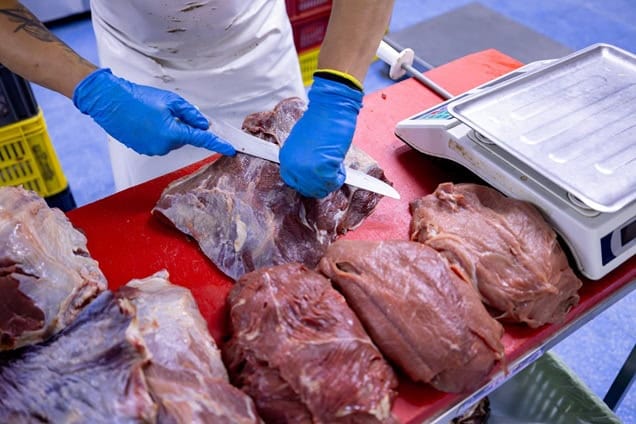
A cutting room is a transformation engine: primals become subprimals, trim streams, portions, and repacks. V5 captures this using Transformation Event Records tied into end-to-end lot genealogy. This is the practical backbone of Western traceability expectations: demonstrate “what became what,” not just “what we think happened.”
Yield is where auditors and customers spot reconstruction quickly. V5 supports yield discipline with First Pass / Final Yield, Yield Variance, Batch Yield Review, and enforcement patterns like Over-Consumption Control and Lot-Specific Consumption Enforcement. This is also how you support mass-balance expectations seen in GFSI programs like SQF mass balance.
5) Variable Weight Control: Catch-Weight Must Be First-Class Data
Meat is variable weight. If weight is treated as “close enough,” your compliance and commercial records diverge. V5 supports variable-weight reality through Catch Weighing and traceable weight linkage via Catch-Weight Traceability, plus reconciliation patterns like Catch-Weight Tote Reconciliation. When weights are governed, you reduce disputes, strengthen label defensibility, and tighten yield integrity in a way auditors can actually trust.
Where trade weights matter, verification is not optional. Controls like Checkweigher Legal-for-Trade Verification help keep weight claims and packaging labels aligned with real-world measurement discipline.
6) Packaging and Weigh Labeling: Treat Labels as Controlled Inventory
Packaging is where most issues become customer-visible and audit-critical. V5 locks labeling behind Controlled Label Print Authorization, prevents cross-SKU drift with Electronic Workstation Line Clearance, and enforces accountability through Label Reconciliation. This is exactly the sort of control that stands up to scheme auditors and customer audits because it prevents “we think we used the right labels.”
For case/pallet and trade labeling, V5 supports identity structure with GS1-128 Case Labels, correctness checks like Carton GTIN Verification, and unitization discipline via Pallet Building / Unit Load Creation. Where applicable, identity markers such as Approved Establishment Numbers and UK Identification Marks fit naturally into the same control model: authorize, verify, reconcile.
7) Food Safety Gates: Make Checks Executable Under Real Standards
“We have a HACCP plan” isn’t the same as “we can prove HACCP execution.” V5 supports execution evidence via In-Process Quality Gates and In-Line Quality Enforcement. It supports inspection regimes like Foreign Material Inspection and verification controls like Metal Detector Verification Tests and X-Ray Validation.
For further processing, V5 can anchor your program to widely recognized Western expectations: FSIS 9 CFR 417 for HACCP structure, lethality discipline in Appendix A, cooling/stabilization under Appendix B, and ongoing risk control narratives like Listeria Control Programs. In the EU/UK context, the operational equivalents show up through hygiene and official control expectations under EU 852/2004, EU 853/2004, and EU 2017/625.
8) Sausage and Blending: Formulation Control Is Traceability Control
Sausage lines are where small errors become big liabilities: spices, cures, and functional ingredients are powerful; rework pressure is real. V5 supports controlled batching through Automated Spice & Functional Additive Batching, verified staging via Spice Pre-Weigh Verification, and sequence discipline using Sequenced Ingredient Weighing. Once mixing starts, reconciliation matters: Mixer-to-Stuffer Reconciliation, load validation such as Mixer-to-Smokehouse Load Validation, and verification through Smokehouse Load Verification Scanning.
This matters in audits because it collapses the “we think we added it” gap. It also strengthens traceability for complex products that move through multiple processing steps, where regulators and customers expect the chain to remain intact from intake to ship.
9) Order Fulfillment and Shipping: Outbound Records Must Match the Pallet
Order fulfillment is where traceability meets commercial reality: substitutions, partials, mixed loads, and last-minute changes. V5 supports disciplined shipment execution using Pack/Ship Compliant Order Fulfillment and pre-advice integrity through ASNs. Shipment identity handover is supported through Bills of Lading and outbound summaries like Shipping Manifests / Carrier Handover Summaries, with segregation logic like Mixed Load Segregation where required.
Commercial standards increasingly look at performance and proof together. V5 supports service metrics like OTIF, while preserving traceability integrity at speed—a key theme in customer audits where “we can ship fast” isn’t accepted as a reason to weaken evidence.
10) Recall Readiness Under Real Pressure: Prove It in Hours, Not Days
The fastest way to expose weak traceability is to run a recall drill honestly. V5 supports that posture through Recall Readiness Testing, Mock Recall Drills, and response expectations such as 24-Hour Record Response. This aligns directly with the most unforgiving audit question: “Show me, right now, exactly where this lot went—and exactly what went into it.”
When your trace chain is built from execution events (not later edits), you can support not only regulatory scrutiny but also escalation workflows like Food Alerts for Action and Food Alerts for Information in jurisdictions where those concepts apply, and you can defend “reasonable steps” and due diligence concepts such as Due Diligence Defence where relevant.
11) Bottom Line: V5 Makes Western Compliance Practical by Refusing Drift
US, EU, UK, and major customer standards all converge on the same operational requirement: reproducible evidence. V5 delivers that by enforcing a small number of hard gates: identity at receipt, governed status via hold/release, genealogy through transformation events, variable-weight integrity through catch-weight, packaging/label controls via authorization and reconciliation, and outbound truth through pack/ship controls. That is what makes audits boring—in the best way—and what makes recall readiness real.
For the meat and sausage-specific overview and positioning, link this article prominently from:
Sausage & Meat Processing Manufacturing.