

Meat Traceability System
Meat Traceability System — Lots, Loads, Catch-Weight & Retail Programs in One Genealogy
This topic is part of the SG Systems Global regulatory & operations glossary.
Updated November 2025 • meat traceability system, USDA/FSIS, GS1-128, catch-weight, foreign material, one-up/one-down traceability • Red Meat, Poultry, Sausage & Deli, Further Processing
A modern Meat Traceability System connects every intake lot, every grind, every mixer, every smokehouse load, every pack, and every pallet into one digital genealogy. It ties GS1-128 intake labels, trim and fat streams, seasoning and functional additions, smokehouse and cooling profiles, metal/X-ray checks, warehouse movements and customer shipments together. It must withstand scrutiny under 9 CFR 417 HACCP, FSIS Appendix A/B, BRCGS meat processing controls, SQF, retailer programs like Walmart SQEP and Costco supplier requirements, and data integrity expectations for electronic records.
“If you can’t answer which supplier lot, which grind, which mixer, which smokehouse load, which pallets, which customers—in minutes—you don’t have a meat traceability system. You have forklifts, hunches and paper.”
TL;DR: A robust Meat Traceability System ties live animal or primal intake, GS1-128 raw-material labels, grind and mix batches, smokehouse and cooling records, packaging-line catch-weight, metal/X-ray checks, cold-store batch-to-bin traceability and outbound one-up/one-down traceability into a single system of record. It gives you a searchable genealogy that supports targeted recalls, mock-recall performance, retailer audits and FSIS visits without spreadsheet archaeology.
1) Why a Meat Traceability System now — hard truths
- Recalls are getting narrower and faster. Regulators and retailers expect lot-precise recalls in hours, not weeks. “Nationwide withdrawal of everything made that week” is a reputational and financial failure, not a safety strategy.
- Catch-weight and rework complicate the story. Variable-weight primals, trim, combo bins, fat streams, rework and leakers all move mass around. If your system can’t reconcile inputs, outputs and loss by lot, you don’t really know where product went.
- Retail programs have teeth. Walmart SQEP, Costco, and QSR chains now assess traceability, labelling and foreign-material control as table stakes. Losing one of these customers can be worse than a minor citation.
- Paper + Excel do not scale. Paper smokehouse charts, clipboards on the grind line and Excel “master” tracking sheets are fragile. One missing sheet or formula error is all it takes to lose the chain.
- Global trade adds complexity. Export programs driven by CFIA SFCR, EU and other regimes expect traceability across borders and plants—not just inside one cooler.
2) Scope of a Meat Traceability System
| Area | What the system controls | Glossary anchors |
|---|---|---|
| Live Animal / Raw Intake | Suppliers, lots, programs, country of origin, intake weights | GS1-128 Raw Material Intake Labeling, COO |
| Trim, Fat & Combos | Deboning streams, trim lots, combo bin IDs, rework sources | Catch-Weight Traceability, Mass Balance |
| Grinding & Mixing | Grind batches, lean/fat ratio, seasoning & functional additions, pre-mix carts | Automated Spice & Functional Additive Batching, Sequenced Ingredient Weighing |
| Smokehouse & Thermal | Load composition, time/temperature curves, lethality, cooling | Mixer-to-Smokehouse Load Validation, Appendix A, Appendix B |
| Packaging & Catch-Weight | Chub IDs, pack weights, label content, overwrap & re-bagging | Packaging Line Catch-Weight Integration, Chub ID & Weight Tracking |
| Case & Pallet Labelling | Case GTIN, lot/date, SSCC pallets, customer codes | GS1-128 Case Label, SSCC |
| Warehouse & Cold Store | Locations, FEFO, batch-to-bin mapping, load building | Batch-to-Bin Traceability, Warehouse Locations |
| Foreign Material Control | Metal detector checks, X-ray validation, rejects, holds | Metal Detector Verification Tests, X-Ray Bone Fragment Detection Validation |
| Regulatory & GFSI | HACCP, CCP/PC records, mock recalls, audits | 9 CFR 417, Mock Recall Performance, BRCGS Meat |
| Customer & Retail Programs | Program codes, pack formats, labelling & SQEP performance | Walmart SQEP, Costco Supplier Requirements |
| Data Integrity | User access, audit trails, retention, e-signatures | Audit Trail, Data Integrity |
| Integrations | MES, WMS, ERP, LIMS, QMS, weighers, labelers, scanners | MES, WMS, LIMS |
3) Intake & raw material identity — foundation of meat traceability
Every genealogy starts at the dock. A Meat Traceability System should treat intake as a controlled, scan-driven process, not a weighing guess and a scribbled combo number.
- Supplier and program identity. Each truck/combo is tied to supplier, establishment number, program (organic, grass-fed, breed claims), and country/region of origin.
- GS1-128 intake labels.
Raw material intake labels encode item, lot, weight, date/time and sometimes chill/kill info, so that every downstream movement can be scanned back to intake. - Lot definition logic. Rules determine how deliveries are split into internal lots (per combo, per shift, per rail). Loose, ad-hoc lotting is a recall nightmare.
- Program segregation. Program and species flags follow the lot into WMS and production, enforcing segregation and preventing accidental mixing of certified and non-certified product.
Once raw material identity is sloppy, everything downstream is approximate; the system is then forced to “approximate” recall scope instead of targeting it.
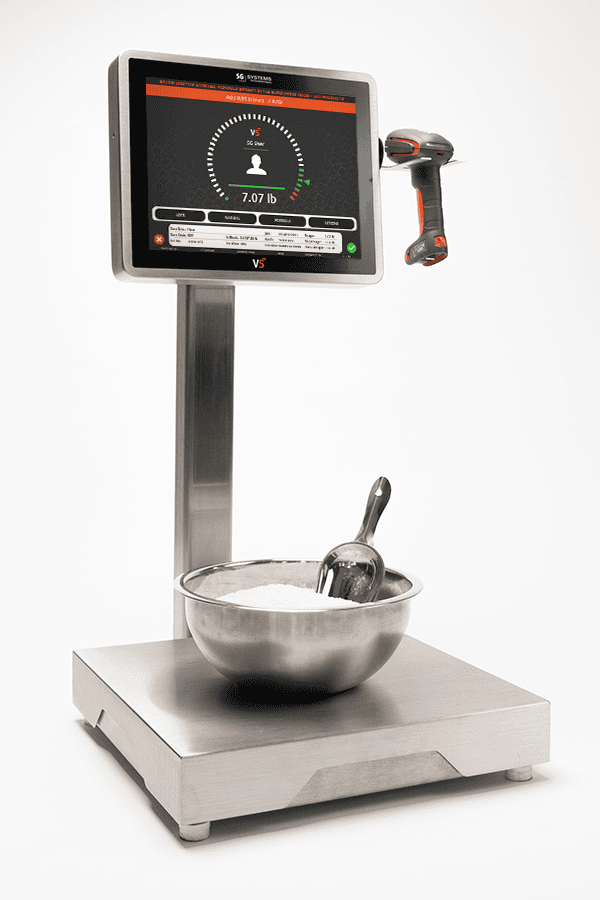
4) Grinding, mixing & catch-weight — where genealogy gets messy
Grind and mix is where traceability usually breaks. Trim and fat from multiple lots are blended, combo bins are topped up, and leakers or rework are tipped back into new batches. A Meat Traceability System needs to enforce structure here:
- Lot-level grind control. Each grind batch uses specific trim/fat lots, scanned at bin or combo level. The system records exact weights and lots used per grind.
- Sequenced ingredient weighing.
Sequenced ingredient weighing controls salt, functional ingredients, ice and water order and quantity, supporting both quality and genealogy. - Pre-mix carts and staging.
Pre-mix cart tracking identifies which pre-mix carts (and therefore which ingredient lots) fed each mixer, preventing “mystery carts”. - Catch-weight sausage batching.
Catch-weight sausage batching functions reconcile variable incoming weights with declared batch sizes and outputs. - Mass balance by batch.
Batch yield reconciliation compares trim issued, lean/fat ratio and additions to finished packs, rework and declared losses.
This is the layer that turns “we think this combo went in there somewhere” into a defensible graph of which precise lots feed which batches.
5) Smokehouse loads, lethality & cooling — linking process to risk
For cooked and smoked products, lethality and cooling are critical hazards. A Meat Traceability System joins product genealogy to thermal and cooling evidence:
- Load composition.
Mixer-to-smokehouse load validation records which mixer batches and racks are loaded into each oven cell or truck. - Load verification.
Smokehouse load verification scanning ensures only expected racks and product types are on each load. - Time/temperature linkage. Oven curves, core-probe readings and hold times are stored as electronic records linked to the load and underlying batches, supporting Appendix A expectations.
- Cooling profiles. Chilling curves and cooler temperatures are associated with the same product sets to support Appendix B stabilization requirements.
- Post-smokepath identity.
Post-smokepath GS1-128 re-labelling keeps product identity intact if items are re-bagged, overwrapped or recased.
If later analysis shows a profile outside the validated envelope, you must be able to identify exactly which lots, cases and customers correspond to that load.
6) Packaging, labels, GS1-128 & retail programs — what leaves the plant
Traceability is ultimately tested at the packaging line and loading dock. A Meat Traceability System must make labels and shipping documents tell the same story as the grind and smokehouse:
- Catch-weight pack control.
Packaging-line catch-weight integration links legal-for-trade scales, labelers and price calculations to the right product and lot. - Chub IDs and verification.
Cooked-chub weight verification and
Chub ID & weight tracking give unit-level traceability where required. - GS1-128 case labels.
Case labels carry GTIN, lot, weight, date and plant codes that downstream systems can scan and interpret. - Pallet identity.
SSCC pallet codes roll up cases into transport units for distribution and recall scope. - Retailer-specific data. Customer-specific fields (program codes, store/region IDs, EDI references) link scans to commercial obligations and scorecards like SQEP.
If the case or pallet labels cannot be decoded back into lots, loads, plants, and dates, real-world traceability is broken no matter what the internal systems claim.
7) Rework, returns & mass balance — closing the loop
Rework, leakers, QC holds and returns are facts of life in meat and sausage plants. A Meat Traceability System must treat them as controlled, traceable flows:
- Rework as a controlled component. Each rework lot has its own ID, genealogy and quality status, and is only allowed in recipes, lines and products with defined limits.
- Returned and downgraded product. Returns and downgrades are scanned back into inventory with their original IDs and reasons, not dumped into a generic “rework bin.”
- Mass balance verification.
Yield reconciliation ensures that intake + rework = finished goods + downgraded + waste/loss; unexplained gaps are investigated. - Mock recall pressure tests.
Mock recall exercises validate that these loops do not break genealogy.
Without rework and return control, recalls either under-scope (miss affected product) or over-scope (destroy unaffected product and margin).
8) Lot genealogy, mock recalls & complaints — joining data to decisions
The real test of a Meat Traceability System is what happens when something goes wrong:
- Upstream genealogy. From a finished lot or complaint, you should be able to see which grind batches, trim lots, pre-mix carts, smokehouse loads and detection checks are involved.
- Downstream exposure. From a suspect intake lot, parameter excursion or detection failure, you should be able to see all packs, cases, pallets, customers and markets affected.
- Mock recalls. Routine mock-recall tests demonstrate that this can be done within defined time limits and with reasonable scope.
- Complaint integration. Complaint records are linked to traceability graphs, so root-cause analysis incorporates real product flow and detection history, not just anecdote.
When this graph exists and is easy to interrogate, recall and complaint programs become fact-based instead of political.
9) Data integrity — trusted meat traceability records
Because traceability records are often used in enforcement, litigation and commercial disputes, they must meet data integrity expectations:
- Unique users & access control. No shared scanner logins; roles and permissions reflect segregation of duties and are reviewed periodically.
- Secure audit trails. Edits to lots, weights, load assignments, detection status and release decisions are recorded with who/what/when/why under GxP audit-trail principles.
- Time synchronization. MES, WMS, smokehouse controls, detection equipment and QMS share time sources, so event order can be reconstructed.
- Retention & archival. Traceability records remain readable and retrievable for the full retention period agreed with regulators and customers, per Record Retention & Archival.
Without these controls, even sophisticated traceability logic can collapse under investigation because the underlying evidence is not trusted.
10) Implementation playbook — building a Meat Traceability System
- Map your flows. Diagram how material moves today: intake, deboning, trim, grind, mix, smokehouse, packaging, warehouse, shipping, rework, returns.
- Stabilize identification. Standardize lot IDs, GS1-128 labels and pallet IDs; kill home-grown code formats that vary by shift or planner.
- Instrument high-risk nodes first. Start with intake, grind/mix, smokehouse, packaging and cold-store batch-to-bin; layer in foreign-material and complaint links next.
- Integrate MES/WMS/ERP. Ensure production, warehouse and commercial systems speak the same language about lots, batches, pallets and customers.
- Define recall playbooks. Build and practice recall/withdrawal scenarios that start from both upstream (supplier lot) and downstream (customer complaint) triggers.
11) How people search for this (and what we cover)
Teams typically search for meat traceability system, USDA meat traceability software, sausage traceability system, GS1-128 meat labels, catch-weight traceability, smokehouse load tracking, foreign material traceability, and mock recall meat plant. This page explains how a Meat Traceability System covers intake, batching, smokehouse, packaging, foreign-material control, warehouse and recalls as one continuous digital genealogy.
12) How this maps to V5 by SG Systems Global
V5 Traceability can act as a full Meat Traceability System by linking intake, batching, smokehouse, packaging and WMS into one enforced model:
- Plant-floor execution. V5 MES controls grind, mixing, smokehouse load formation and validation, and packaging-line catch-weight.
- Warehouse & distribution. V5 WMS maintains batch-to-bin mapping, FEFO and outbound load building.
- Quality & foreign material. V5 QMS ties complaints, deviations and CAPAs to specific lots and events; metal/X-ray systems can be integrated via the V5 Connect API.
- End-to-end genealogy. The combined platform enables one-click genealogy from intake lot to pallet and customer, and back again, supporting targeted recalls and SQEP-style audits.
See the overall landscape in the V5 solution overview.
13) KPIs that prove meat traceability control
- Lot coverage: % of intake and production lots with complete genealogy from intake to shipment (target 100%).
- Mock recall time: time from trigger (supplier lot or complaint) to final, documented list of affected lots and customers.
- Mass balance closure: % of batches where intake vs. output + waste is reconciled within defined tolerance.
- Detection linkage: % of metal/X-ray rejects and verification tests linked to lots and loads in the system.
- GS1-128 adoption: % of cases and pallets shipped with standards-compliant GS1-128 and SSCC identifiers.
- Untraceable product: count of lots/pallets that cannot be traced with full upstream/downstream context (target zero).
14) Common pitfalls
- Combo numbers on a whiteboard. Intake IDs live on a board or in someone’s notebook, not in a system of record.
- “We only change labels at the printer.” Labels are edited on the line instead of being controlled as documents linked to product and customers.
- Unlogged rework. Leakers and QC holds are dumped into generic rework with no link back to original lots.
- Excel-only genealogy. Traceability depends on a fragile set of spreadsheets that break as volume and SKUs grow.
- No regular mock recalls. The first time the system is “tested” is during a real incident—with predictable chaos.
- Disconnected plants and cold stores. Third-party cold storage or contract processors do not share common IDs or scanning discipline.
15) Quick-start checklist for a Meat Traceability System
- Standardize lot IDs for intake, trim, grind, mix, smokehouse loads and finished goods.
- Roll out GS1-128 intake, case and pallet labels with scannable data.
- Capture grind and batch genealogy in a system, not just in notebooks.
- Link smokehouse data (loads and profiles) directly to batches and lots.
- Implement batch-to-bin mapping in cold stores, including third-party facilities where possible.
- Practice at least one mock recall per year per major product family, using the live system and real operators.
16) Extended FAQ
Q1. What is a Meat Traceability System?
A Meat Traceability System connects intake lots, grind and mix batches, smokehouse loads, packaging, warehouse locations and customer shipments into a single genealogy. It lets you trace meat products backwards to suppliers and forwards to customers with lot-level precision.
Q2. How is a Meat Traceability System different from a standard WMS?
A WMS focuses on inventory locations and movements. A Meat Traceability System adds grind/mix genealogy, smokehouse and cooling records, foreign-material checks, catch-weight data and recall tooling on top of warehouse visibility.
Q3. Can we implement meat traceability without replacing our ERP?
Often, yes. Many plants keep ERP as the financial and order backbone while layering MES, traceability and WMS capabilities around it, using GS1-128 labels and APIs to keep IDs aligned.
Q4. How does a Meat Traceability System handle catch-weight?
It records actual weights at intake, batching and packaging, ties them to lots and labels, and reconciles them through mass-balance logic so that variable weights don’t break genealogy.
Q5. How does this help with recalls and withdrawals?
If a supplier lot, smokehouse profile, detection failure or complaint is implicated, you can quickly identify all affected batches, lots, cases, pallets and customers—without over- or under-scoping the recall.
Q6. What data is required at minimum?
Stable lot IDs, consistent GS1-128 usage, scanned movements at each major step, integration of smokehouse and detection events, and a way to tie shipments to lot IDs are the core foundation.
Q7. Does a Meat Traceability System also improve yield?
Yes. Once every movement and transformation is captured, it becomes much easier to see where trim, fat, purge, leakers and waste are occurring—and to attack that loss without losing traceability.
Q8. What is the minimum viable Meat Traceability System?
Controlled lot IDs, GS1-128 labelling at intake and case/pallet level, basic grind/mix genealogy, batch-to-bin mapping in cold store, and a simple recall tool that can answer “where did this lot go?” and “what finished product used this lot?” within hours.
Related Reading
• Foundations: Traceability (End-to-End Lot Genealogy) | One-Up / One-Down Traceability | Mass Balance | Mock Recall Performance
• Meat & Sausage Controls: BRCGS Meat Processing Controls | FSIS Appendix A | FSIS Appendix B | Catch-Weight Tote Reconciliation
• V5 Products: V5 Solution Overview | V5 MES | V5 WMS | V5 QMS | V5 Connect API
OUR SOLUTIONS
Three Systems. One Seamless Experience.
Explore how V5 MES, QMS, and WMS work together to digitize production, automate compliance, and track inventory — all without the paperwork.

Manufacturing Execution (MES)
Control every batch, every step.
Direct every batch, blend, and product with live workflows, spec enforcement, deviation tracking, and batch review—no clipboards needed.
- Faster batch cycles
- Error-proof production
- Full electronic traceability

Quality Management (QMS)
Enforce quality, not paperwork.
Capture every SOP, check, and audit with real-time compliance, deviation control, CAPA workflows, and digital signatures—no binders needed.
- 100% paperless compliance
- Instant deviation alerts
- Audit-ready, always

Warehouse Management (WMS)
Inventory you can trust.
Track every bag, batch, and pallet with live inventory, allergen segregation, expiry control, and automated labeling.
- Full lot and expiry traceability
- FEFO/FIFO enforced
- Real-time stock accuracy
You're in great company

















How can we help you today?
We’re ready when you are.
Choose your path below — whether you're looking for a free trial, a live demo, or a customized setup, our team will guide you through every step.
Let’s get started — fill out the quick form below.