
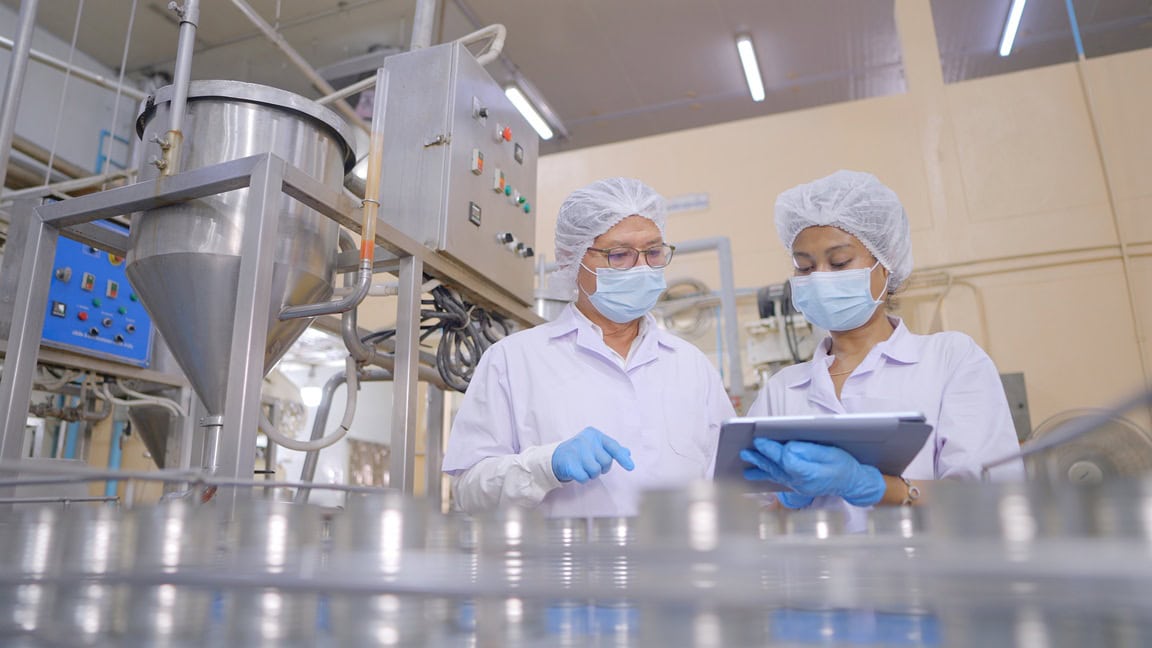
Bakery Batch Production
Bakery Batch Production
This topic is part of the SG Systems Global Guides library for bakery teams evaluating batch execution control, weigh/dispense discipline, yield governance, labeling controls, and traceability readiness.
Updated January 2026 • bakery batch production, batch tickets, electronic batch record, weigh and dispense, in-process quality gates, label control, yield reconciliation, traceability • Bakery Manufacturing
Bakery batch production is the operational discipline of turning formulas into repeatable, auditable, on-time output—without turning your floor into a paperwork factory. In a real bakery, “batch production” is not just mixing dough. It’s the full chain: scaling ingredients accurately, staging and moving material without losing truth, executing a defined sequence (mix → rest/ferment → divide → proof → bake → cool → pack), managing changeovers, preventing allergen and label failures, and reconciling yield so finance isn’t guessing and production isn’t constantly firefighting shortages that “shouldn’t exist.”
Most bakeries don’t fail because they can’t bake. They fail because the system of work doesn’t hold up under pressure. When the line is behind, people improvise: they swap lots without recording it, pull packaging “from wherever,” skip checks, and fix the story later. That keeps today moving—but it breaks tomorrow: inventory drifts, FEFO collapses, yield turns into an argument, and traceability becomes a panic event. If you’re scaling, wholesaling, or serving audited customers, that approach eventually hits a wall.
This guide is written for operators and leaders who want batch production to run like a controlled system instead of a daily negotiation. It covers the practical building blocks: how to define batch boundaries, how to structure a Batch Ticket that is actually executable, how to enforce weigh/dispense and staging, where to put quality gates so they prevent rework instead of creating it, and how to connect batch records, yield, labeling, and genealogy into a single chain of evidence.
“A bakery doesn’t scale on recipes. It scales on repeatable execution under pressure.”
TL;DR: Bakery batch production works when your “standard work” survives the worst day. Start by making the batch executable: define your Master Recipe, manage versions with recipe versioning, and turn it into a shop-floor batch ticket that drives Batch Recipe Execution. Then enforce readiness: staging and kitting, minor pre-weigh verification, and weigh/dispense automation backed by scale integration and scanning (barcode scanners). Put quality where it stops bad product early: IPC checks, verification, and hold triggers when limits fail. Treat labeling as production control, not an afterthought: line clearance, label reconciliation, and controlled artwork (artwork versioning). Close the loop with yield truth: batch balancing and yield reconciliation. If you can’t prove what was used, what was checked, and what was shipped within minutes, you don’t have controlled batch production—you have a story.
Table of Contents
- What bakery batch production really means
- Batch boundaries: what is “a batch” in a bakery?
- From recipe to executable batch ticket
- Scaling formulas without breaking quality
- Material readiness: staging, kitting, and weigh/dispense
- Execution control: steps, sign-offs, and “do it right” speed
- In-process quality gates that prevent rework
- Changeovers, allergens, and sanitation verification
- Packaging + labeling control in batch production
- Yield, giveaway, and reconciliation
- Traceability + recall readiness as a daily capability
- Exceptions, deviations, and rework without losing truth
- Scheduling + dispatch for batch bakeries
- System stack: MES/WMS/QMS/ERP roles
- KPIs and management routines
- Copy/paste demo script and selection scorecard
- How this maps to V5 by SG Systems Global
- Extended FAQ
1) What bakery batch production really means
Batch production in a bakery is the discipline of producing a defined quantity of product from a defined formula, using a defined sequence, with defined checks, and a defined evidence trail. That last part—evidence—is what separates “we made it” from “we can prove we made it correctly.”
In practice, bakery batch production has three simultaneous goals:
- Product consistency: dough handling, hydration, bake profile, and finish must land inside spec.
- Operational predictability: schedules must be believable, shortages must be rare, and downtime must be explainable.
- Defensible control: what lots were used, what checks were performed, and what packaging was applied must be provable without detective work.
Most bakeries unintentionally prioritize only the first goal. They rely on “tribal knowledge” to keep quality acceptable and accept chaos as normal. That works until you add scale: more SKUs, more shifts, more changeovers, more customers, and more audit expectations. At that point, the old model collapses because it depends on heroes.
Simple reality check
If “we’ll fix it in the batch record later” is common language, you don’t have batch production control—you have batch production reconstruction.
2) Batch boundaries: what is “a batch” in a bakery?
A bakery has multiple natural batch boundaries, and you have to pick the ones that matter for your controls and traceability.
- Mix batch: one mixer load of dough/batter. Often the cleanest boundary for ingredient consumption truth.
- Oven batch/run: product baked under a specific bake profile. Useful when bake parameters are the primary risk driver.
- Packaging batch: product packaged under one label/artwork revision, code setup, and packaging material set. Critical for label and retailer compliance.
- Ship lot: what actually leaves the building to a customer, which is what traceability and complaints ultimately reference.
The mistake is assuming these are always the same. They aren’t. A single mix batch can be split into multiple packaging batches (multiple SKUs or pack sizes). Multiple mix batches can be combined into a packaging run. Rework can cross boundaries. If your system can’t represent those realities, your records will drift or get simplified into fiction.
For teams building tighter traceability, start with one rule: your batch boundary must preserve identity. You should be able to answer: which ingredient lots and packaging identities were used to produce each finished lot? That’s the core of end-to-end traceability.
3) From recipe to executable batch ticket
A “recipe” is not enough for a commercial bakery. A recipe is descriptive. Batch production requires something executable—meaning it drives what people do, in what order, with what checks, and with what required evidence.
At a minimum, an executable batch definition includes:
- Formula and target quantities (in weight-based units, not “cups”).
- Sequence and timing (what happens first, what cannot be skipped).
- Critical parameters (hydration, mix time, dough temperature, proof targets, bake targets).
- Required checks (in-process checks, allergen/changeover verification, label verification).
- Evidence expectations (scan/weight, sign-offs, results capture, and exceptions).
This is why mature bakeries formalize master recipes and manage them through master recipe control and versioning change control. Your shop floor should run a batch ticket or digital traveler that is generated from that controlled master—and then executed as a real workflow, not as a document that’s filled out after the fact.
If you capture batch evidence electronically, your batch ticket becomes a true Electronic Batch Record (EBR) or electronic batch manufacturing record (eBMR). Whether you call it EBR or eBMR, the point is the same: the record must be a product of controlled execution, not a story written later.
Tell it like it is:
If your “batch record” can be completed without proving what was weighed, scanned, verified, and checked, it’s a form—not a control.
If your “batch record” can be completed without proving what was weighed, scanned, verified, and checked, it’s a form—not a control.
4) Scaling formulas without breaking quality
Scaling a bakery formula is not just multiplying ingredients. Larger batches change mixing energy, heat transfer, absorption, and dwell times. The right way to scale is to preserve ratios and preserve process intent.
Practical rules that hold up in commercial bakeries:
- Move to weight-based formulas. Volume is too variable at scale.
- Use percentages where possible. Baker’s percent turns scaling into math instead of guesswork (see Baker’s Percent).
- Track loss and yield. Moisture loss in bake is real and must be managed (see moisture loss and bake yield testing).
- Test scaled batches before committing. Small test runs catch mixing and proofing drift early.
- Separate “formula” from “process.” A stable formula can still fail if the process window isn’t defined and enforced.
From a controls standpoint, scaling also forces a decision about ingredient handling: do you run minors as a pre-weigh process (recommended when minors matter), or do you dose in-line? Both can be valid—what matters is control. A common maturity path is: start with pre-weigh verification, then graduate into weigh/dispense automation as volume and complexity grow.
5) Material readiness: staging, kitting, and weigh/dispense
Material readiness is where batch production either becomes predictable or becomes daily improvisation. The floor can’t execute a stable batch sequence if the right materials aren’t staged, the right lots aren’t available, or minor ingredients are being measured “by feel.”
In a disciplined model, readiness is engineered through:
- Controlled staging and kitting: treat staging as a real inventory location, not a black hole (see Material Staging and Kitting and Kitting).
- Identity confirmation: verify what you picked is what you need (see Material Identity Confirmation).
- Micro and macro discipline: dose minors tightly; manage bulk adds efficiently (see Micro Ingredient Dosing and Macro Dosing).
- Scale + scanner integrations: remove manual typing and make correct capture fast (see Weigh Scale Integration and Barcode Scanner Integration).
One direct “tell” of maturity: can you stop a batch from starting when readiness is not met? If you can’t, you are depending on a supervisor’s memory and urgency decisions. That’s not control—it’s hope.
| Readiness model | What it looks like | What it causes | Best-fit stage |
|---|---|---|---|
| Ad hoc staging | “Grab what you need” from warehouse and line-side caches | Shortages, substitutions, inventory drift, weak genealogy | Early-stage, low SKU count |
| Partial control | Some kitting/staging, but identity and returns are inconsistent | Improved flow, but ongoing variance and periodic “mystery shortages” | Growing wholesale bakeries |
| Controlled readiness | Staging and kitting are controlled, identity is verified, exceptions are governed | Predictable starts, fewer stops, credible inventory and yield | Scaled, audited, multi-shift |
6) Execution control: steps, sign-offs, and “do it right” speed
Batch production is executed through steps. If steps are optional, execution becomes optional. That’s why many serious operations implement step enforcement concepts from MES thinking: define steps, define evidence, enforce sequence, and make exceptions explicit.
At the shop-floor level, execution control usually includes:
- Digital work instructions: reduce “tribal knowledge” risk (see Digital Work Instructions and EWI Management).
- Sign-offs with meaning: not “I clicked complete,” but “I verified X” (see Electronic Operator Sign-Off).
- Operator action validation: making sure actions match the step’s context (see Operator Action Validation).
- Step-level enforcement: stopping skip-ahead and missing evidence behavior (see Step-Level Execution Enforcement).
Here’s the non-negotiable: the compliant path must be the fastest path. If your control model makes the floor slower than the workaround, people will work around it—every time. Integration (scales, scanners, label printers) isn’t “nice tech.” It’s how you make control fast.
7) In-process quality gates that prevent rework
Quality gates in a bakery are not about making operators “do QC.” They’re about catching failure while it’s still cheap to fix. A failed check at mix time is a rework event. A failed check after packaging is a scrap event—or worse, a customer event.
Two core concepts make gates work:
- In-process control checks (IPC): measurements, observations, and limits (see IPC).
- In-process verification (IPV): a second-person or system validation for higher-risk steps (see IPV).
Then you need consequence. If a limit fails, the system should not just record it. It should route the batch into an exception state—often a hold—until dispositioned. That is the operational value of automated controls like Automated Hold Trigger Logic and Automated Execution Hold Logic.
| Control style | What it does | Why it fails under pressure | What to implement instead |
|---|---|---|---|
| Soft check | Captures a value and “warns” if out of range | Warnings get clicked through; review becomes forensic | Gate + exception workflow with reason capture and disposition |
| Hard gate | Blocks completion/advance until limits are met or exception approved | Only fails if bypasses are allowed | Hard gate + governed overrides + audit trail |
When gates are designed correctly, they reduce workload. The floor stops creating defects that QA must later investigate. That’s the point.
8) Changeovers, allergens, and sanitation verification
Changeovers are where bakeries bleed capacity and where risk spikes. The two failure modes are predictable:
- Incomplete clearance: old materials, old labels, old trays, and old “stuff” remain and contaminate the next run.
- Rushed verification: checks become a checkbox because the schedule is tight.
A serious batch production model treats changeover as a controlled sequence with proof. Common controls include:
- Packaging line clearance verification as a required pre-start gate.
- Allergen changeover verification when allergen profile changes across runs.
- Cleaning verification to prevent “we cleaned” without evidence.
- Allergen cross-contact risk thinking that’s encoded into workflow, not just training.
Tell it like it is: if you rely on memory to manage allergen changeovers, you’re not managing allergens—you’re gambling with them. Encode the requirements, enforce the sequence, and require evidence.
9) Packaging + labeling control in batch production
Packaging is where batch production meets customer compliance. You can bake perfect product and still lose the shipment due to wrong artwork, wrong barcode, wrong case label, or missing label reconciliation.
Three packaging controls matter most in batch bakeries:
- Component identity verification: prove the right packaging components are staged and used (see Component Identity Barcode Verification).
- Label governance: treat labels as controlled inventory with reconciliation (see Label Reconciliation).
- Artwork and claims control: ensure the label version is the one approved for that customer and product (see Artwork Versioning and Label Copy Control).
Operationally, packaging control becomes easier when your tools are integrated:
- Label Printer Integration to reduce manual printing errors and ensure the right templates are used.
- Barcode Scanner Integration to validate component identity at the point of use.
Buyer reality:
If your packaging process can’t prove label version + component identity + clearance completion, your compliance is based on “we think.” That doesn’t survive scale.
If your packaging process can’t prove label version + component identity + clearance completion, your compliance is based on “we think.” That doesn’t survive scale.
10) Yield, giveaway, and reconciliation
Yield is not a finance metric. Yield is an execution truth metric. If yield is wrong, you either have a process problem, a recording problem, or both. And if you don’t fix it, you will keep paying for it through:
- phantom shortages
- overproduction “just to be safe”
- unexplained margin leakage
- arguments between ops and finance
Batch bakeries typically need three layers of yield discipline:
- Batch balancing: reconcile inputs, outputs, and known losses (see Batch Balancing).
- Yield variance tracking: plan vs actual output as a management signal (see Yield Variance).
- Formal reconciliation: a structured close process for each batch (see Batch Yield Reconciliation and Batch Yield Review).
In bakeries that sell by weight or manage variable-weight products, the “giveaway” problem can dominate yield. That’s where disciplines like Catch Weighing and understanding TNE become practical—not theoretical. Overfill might feel like “quality,” but it’s usually uncontrolled cost.
11) Traceability + recall readiness as a daily capability
Traceability is a daily capability or it’s useless when you need it most. The goal is not “we can trace if we have a day.” The goal is: minutes.
To achieve that, batch production must preserve identity through the entire flow:
- ingredient lots received and located correctly
- lots staged to the batch with visibility preserved
- actual consumption tied to the batch boundary
- packaging identity tied to packaging batches
- finished goods lots linked to shipments
This is the operational meaning of lot genealogy and chain of custody. When your data capture is consistent, a recall drill becomes a routine exercise, not a crisis rehearsal. When your capture is inconsistent, traceability becomes an emergency project.
For the management framing, focus on recall readiness: speed to scope, speed to hold, speed to customer communication, and confidence in the scope boundaries. Batch production discipline is what makes that possible.
12) Exceptions, deviations, and rework without losing truth
Every bakery runs exceptions. The question is whether exceptions teach you something or quietly erode control.
Typical exception classes in batch bakeries include:
- ingredient substitutions
- out-of-range process values (mix temp, proof time, bake profile)
- packaging component shortages or swaps
- rework and repack events
- scrap/reject events (quality or operational)
The trap is letting exceptions become “notes.” Notes don’t stop bad release decisions and they don’t prevent repeat issues. Mature shops treat exceptions as governed workflows tied to Deviation Management and Nonconformance.
Rework must be handled with traceability intact. If rework becomes anonymous “dough scrap” with no identity, you will eventually lose control of allergens, lot genealogy, and yield. When rework is a major lever in the operation, use formal controls like Rework Controlled Reprocessing and Rework/Repack Traceability. For truly off-spec production that is being salvaged, ensure the workflow aligns with off-spec batch rework discipline.
13) Scheduling + dispatch for batch bakeries
Scheduling is where bakery plans meet bakery constraints: labor, ovens, proofers, mixers, packaging availability, allergens, changeovers, and shelf-life. A schedule that ignores constraints is not a schedule—it’s a wish list.
Batch bakeries often stabilize by separating two concerns:
- Planning: what should be made and when, at a high level (see Production Scheduling).
- Dispatch: what is released to the floor right now, based on readiness and constraints (see Job Queue).
The dispatch layer matters because it protects the floor from starting work that will predictably stall (missing materials, changeover not complete, packaging unavailable). If dispatch ignores readiness, you get half-started batches, WIP congestion, and a constant “priority reshuffle.” That’s how bakeries lose hours without knowing where they went.
Dispatch rule that works
Only release a batch to execution when staging and packaging readiness are provably complete. Otherwise your WIP becomes your warehouse.
14) System stack: MES/WMS/QMS/ERP roles
Batch production stability is usually a system-of-systems problem. Most bakeries already have an ERP. The question is where execution truth should live and how to keep one version of reality.
A practical operating model looks like this:
- ERP: financial system of record (purchasing, costing, customer orders) — see ERP.
- WMS: physical inventory control (receiving, putaway, picking, staging) — see WMS.
- MES: execution truth (batch steps, consumption, checks, genealogy) — see MES.
- QMS: exceptions, investigations, holds, and release governance — see QMS.
For many bakeries, the most important integrity foundation is data discipline: if you’re recording execution and release decisions electronically, you need data integrity, an audit trail mindset for critical events, and a realistic record retention plan. Even when you’re not in pharma, the operating logic is the same: if it matters, it must be attributable and reviewable.
15) KPIs and management routines
If you don’t measure batch production control, you’re managing by vibe. Keep KPIs few, operational, and tied to behaviors.
OEE
Use OEE to expose where time is actually going (changeovers, stops, performance loss).
Use OEE to expose where time is actually going (changeovers, stops, performance loss).
OTIF
OTIF reveals whether your batch system can keep promises without expedites.
OTIF reveals whether your batch system can keep promises without expedites.
First-pass yield
Track first-pass final yield to see how often you “get it right the first time.”
Track first-pass final yield to see how often you “get it right the first time.”
Trace response time
Run a weekly trace drill; your “minutes to scope” is a real capability metric.
Run a weekly trace drill; your “minutes to scope” is a real capability metric.
Then run the management loop weekly:
- Review yield variance drivers by product family and shift.
- Review top downtime causes (especially changeovers and waiting on materials).
- Review label/packaging exceptions and clearance failures.
- Review rework volume and why it happened.
- Run one traceability drill and document time-to-scope and time-to-hold.
If your KPI reviews don’t result in process changes, they’re entertainment. The point is to change the system of work.
16) Copy/paste demo script and selection scorecard
Batch production software demos are easy to stage. Force reality: wrong lots, missing packaging, out-of-range checks, and rework. Use these scripts to separate “pretty screens” from real control.
Demo Script A — Weigh/Dispense Truth
- Run a minor-ingredient step using scale integration.
- Attempt to enter a value manually or weigh the wrong ingredient lot.
- System should block or force a governed exception with reason capture.
Demo Script B — Changeover + Allergen Control
- Start a run requiring allergen changeover verification.
- Try to skip clearance or verification.
- System must block start until required evidence is captured.
Demo Script C — Label Version + Component Identity
- Stage packaging components and validate with barcode verification.
- Attempt to use a wrong component or wrong label revision.
- System must block and record the denied attempt.
Demo Script D — Traceability Drill
- Select an ingredient lot and run forward trace to finished lots and shipments.
- Select a finished lot and run backward trace to ingredient lots and packaging identity.
- Generate a scope report and place impacted lots on hold within minutes.
| Dimension | What to score | What “excellent” looks like |
|---|---|---|
| Readiness enforcement | Staging/kitting + identity control | Batch cannot start without readiness evidence; staging remains visible and controlled. |
| Weigh/dispense control | Scales + minor verification | Device-captured weights; wrong lots blocked; exceptions governed. |
| Packaging control | Clearance + label governance | Line clearance enforced; label reconciliation; wrong artwork blocked. |
| Quality gates | IPC/IPV + hold logic | Out-of-range results trigger holds and required dispositions, not “notes.” |
| Yield truth | Reconciliation workflow | Batch balancing and yield reconciliation are structured and fast, not forensic. |
| Traceability speed | Minutes-to-scope | Backward/forward trace in minutes with clear scope boundaries and holds. |
17) How this maps to V5 by SG Systems Global
V5 supports bakery batch production by combining execution enforcement with inventory and quality governance. In practical terms: it helps you make the compliant path the fastest path—so weigh/dispense, staging, checks, and packaging controls don’t collapse under schedule pressure.
- Execution truth (batch steps, checks, e-records): V5 MES
- Inventory truth (receiving, staging, traceable moves): V5 WMS
- Quality governance (holds, deviations, dispositions): V5 QMS
- Integration layer (ERP/devices/automation): V5 Connect API
- Platform overview: V5 solution overview
Neutral framing: if you’re small, a lightweight system you actually use can beat a heavy system you bypass. But if you’re scaling—more SKUs, more shifts, more audited customers—the system that wins is the one that enforces readiness, identity, checks, and labeling without slowing the floor. That’s the “execution + governance” lane V5 is built for.
18) Extended FAQ
Q1. What is bakery batch production?
Bakery batch production is the controlled execution of a defined formula and process sequence (mix to pack) with required checks and a defensible evidence trail.
Q2. What’s the most common reason batch production becomes chaotic?
Uncontrolled staging and substitutions. When staging is a black hole, inventory and traceability drift and the floor is forced into improvisation.
Q3. Do I need electronic batch records in a bakery?
If you’re scaling, wholesaling, serving audited customers, or struggling with yield and traceability—electronic capture often becomes the fastest path to stability.
Q4. Where should I place quality gates?
Put them where failure is still cheap to fix: weigh/dispense, pre-start clearance, early in the process, and before packaging/ship.
Q5. What’s a fast way to test if our traceability is real?
Run a weekly drill: pick one ingredient lot and trace forward to customers, then pick one finished lot and trace backward to ingredients and packaging—time it.
Related Reading
• Bakery context: Bakery Manufacturing
• Batch execution: Batch Ticket | Batch Manufacturing Record (BMR) | Batch Recipe Execution | Electronic Batch Record
• Weigh/dispense + readiness: Material Staging and Kitting | Pre-Weigh Verification | Weigh and Dispense Automation | Weigh Scale Integration
• Packaging controls: Packaging Line Clearance Verification | Label Reconciliation | Artwork Versioning
• Yield + traceability: Batch Yield Reconciliation | Traceability | Recall Drill
• V5 products: V5 MES | V5 WMS | V5 QMS | V5 Connect API
OUR SOLUTIONS
Three Systems. One Seamless Experience.
Explore how V5 MES, QMS, and WMS work together to digitize production, automate compliance, and track inventory — all without the paperwork.

Manufacturing Execution System (MES)
Control every batch, every step.
Direct every batch, blend, and product with live workflows, spec enforcement, deviation tracking, and batch review—no clipboards needed.
- Faster batch cycles
- Error-proof production
- Full electronic traceability

Quality Management System (QMS)
Enforce quality, not paperwork.
Capture every SOP, check, and audit with real-time compliance, deviation control, CAPA workflows, and digital signatures—no binders needed.
- 100% paperless compliance
- Instant deviation alerts
- Audit-ready, always

Warehouse Management System (WMS)
Inventory you can trust.
Track every bag, batch, and pallet with live inventory, allergen segregation, expiry control, and automated labeling—no spreadsheets.
- Full lot and expiry traceability
- FEFO/FIFO enforced
- Real-time stock accuracy
You're in great company

















How can we help you today?
We’re ready when you are.
Choose your path below — whether you're looking for a free trial, a live demo, or a customized setup, our team will guide you through every step.
Let’s get started — fill out the quick form below.