

Batch Weighing System
Batch Weighing System — Controlled Multi-Ingredient Dosing, Lot Identity & GMP Evidence
This topic is part of the SG Systems Global regulatory & operations glossary.
Updated November 2025 • batch weighing system, batch weighing, gain-in-weight, loss-in-weight, manual & automatic dosing, tolerance enforcement, traceability, data integrity • Food, Dietary Supplements, Pharma, Cosmetics, Chemicals, Meat & Sausage, Bakery, Plastic & Resin, Ingredients & Dry Mixes
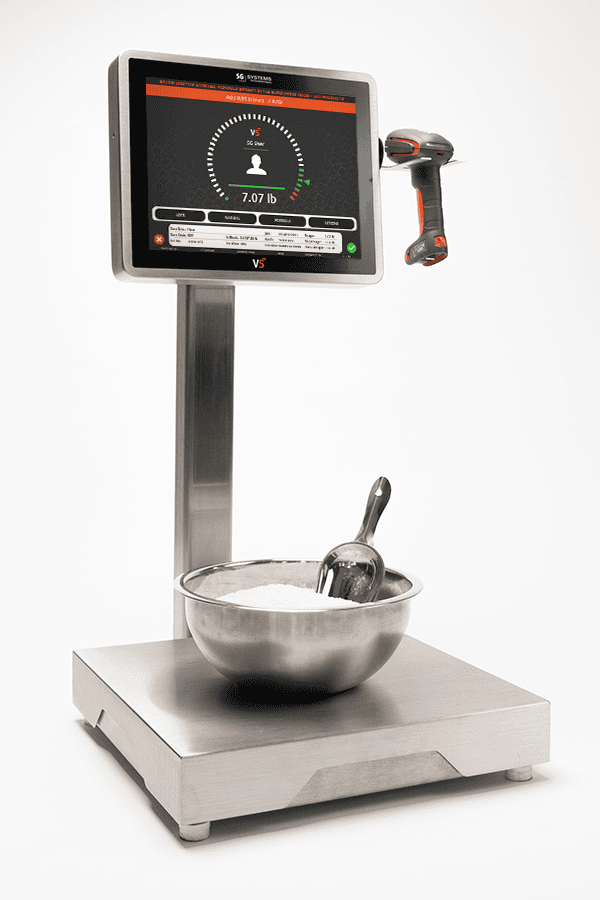
A modern Batch Weighing System is the combination of scales, feeders, recipe logic and traceability software that controls how multiple ingredients are weighed into a batch. It may include manual floor scales, micro-ingredient stations, gain-in-weight vs loss-in-weight feeding, bulk silos, tote stations and liquid dosing—but from a quality and regulatory point of view, it behaves as one controlled system. It knows which formula is running, which materials and lots are permitted, which scales and feeders are qualified, and what tolerances and sequences apply.
Unlike a simple bench scale, a Batch Weighing System produces a complete, attributable record for each batch: what was weighed, how much, using which device, from which lot, by whom, and when—feeding directly into BMR/eBMR and lot genealogy.
“If your batch weighing can’t show per ingredient: target, tolerance, actual, lot, scale, time, operator—on demand—then it isn’t a Batch Weighing System. It’s a pile of hardware.”
TL;DR: A Batch Weighing System orchestrates how multiple ingredients are weighed into each batch—across silos, feeders and manual stations. It drives batch weighing with controlled recipes, per-ingredient tolerances, gain-in-weight / loss-in-weight logic, barcode-based identity, scale calibration checks and audit trails. It builds a defendable history that feeds MES, BMR/eBMR, WMS and lot traceability for regulated and high-risk manufacturing.
1) Why a Batch Weighing System now—hard truths
- Uncontrolled batching is a hidden root cause. Many “process problems” trace back to inconsistent dosing, missing ingredients or unlogged substitutions at the weigh stage.
- Regulators and customers expect more than setpoints. Food, pharma, supplements and cosmetics all need to show not just targets, but actual delivered weights and lots per batch.
- Automation without records is a liability. PLC-based automatic batching that leaves no audit trail for who changed what, when, will not withstand scrutiny under GFSI or GMP.
- Yield and cost depend on genuine mass data. You cannot trust mass balance, yield or waste metrics if your batch weighing numbers are estimates or manually transcribed.
- Traceability is only as strong as the weigh point. If you cannot prove which material lots actually entered a batch, recalls and investigations become guesswork.
2) Scope of a Batch Weighing System
| Area | What it controls | Glossary anchors |
|---|---|---|
| Formula & Recipe Setup | Ingredient list, targets, tolerances, scale/feeder assignments, addition order | Products & Formulas, BOM |
| Manual vs Automatic Weighing | Floor scales, micro-weighing, automatic feeders and liquid dosing under one model | Gravimetric Weighing |
| Gain-in-Weight / Loss-in-Weight Control | Feeder modes, fast/dribble feed, cut-off and overshoot handling | Gain-in-Weight vs Loss-in-Weight Feeding |
| Material Identity & Lots | Lot-to-silo mapping, barcode scans at manual stations, QA hold/expiry gating | Material Identity Confirmation, FEFO |
| Tolerances & Interlocks | Per-ingredient tolerance bands, hard gates, exception paths | Hard Gating, Control Limits (SPC) |
| Scale & Feeder Assets | Device IDs, calibration, verification, locations and qualification state | Asset Calibration Status, IQ/OQ/PQ |
| Allergens & Zoning | Lines and feeders with allergen restrictions, sequence rules, changeovers | Allergen Control Program |
| Rework & Yield | Rework additions, reclaim limits, yield/mass-balance reporting | Rework Traceability, Mass Balance |
| Batch Records & Genealogy | Per-batch weight logs, lot usage, links to BMR/eBMR and traceability | Batch Weighing, Lot Traceability |
| Data Integrity & Audit | Users, roles, e-signatures, audit trails, time sync, retention | Data Integrity, Audit Trail (GxP) |
| Integrations | Interfaces with ERP, MES, WMS, SCADA/PLC and LIMS | MES, WMS |
3) Manual and automatic batch weighing—one system, different stations
A Batch Weighing System typically spans:
- Manual stations. Floor scales, bench scales and micro-balances where operators hand-weigh small or high-risk ingredients, guided by on-screen instructions and barcode checks.
- Automatic batching. Silo-fed gain-in-weight hoppers, loss-in-weight feeders and liquid dosing skids under PLC or DCS control, supervised by recipe logic and Batching Scale Software.
- Hybrid setups. Systems where bulk ingredients are automated and minors/micros are manual—but all weights, lots and devices still flow into a single batch history.
The key is that manual and automatic contributions are captured in the same data model, so QA, planners and auditors see one coherent picture per batch, not a patchwork of paper tickets and PLC counters.
4) Gain-in-weight and loss-in-weight strategies inside a Batch Weighing System
Batch Weighing Systems hide the complexity of different dosing technologies behind consistent recipe behavior:
- Gain-in-weight hoppers. For dry materials, the system sequences feeders into a hopper on a scale, watching mass increase to target + cut-off and logging actuals and overshoot per ingredient.
- Loss-in-weight feeders. For continuous or semi-continuous feeds, the system monitors hopper mass decrease, controlling feed rates and recording delivered mass over time.
- Liquids. Flow meters and load cells can be combined: Batching logic may use density and temperature corrections to calculate true mass and log that value in the batch record.
In all cases, the operator sees “ingredient, target, tolerance, actual, status,” not raw load-cell signals or unlabelled PLC tags.
5) Material identity & lot mapping—the foundation of traceable batch weighing
A Batch Weighing System must know which lot is in each device at all times:
- Lot-to-device assignment. When silos or hoppers are filled, lots are assigned and confirmed (via barcode or manual entry) in the system, not just on clipboards.
- Status enforcement. Lots on QA hold, expired, or restricted for specific products are blocked from use at the device level.
- Top-ups and blends. If multiple lots are blended in a device, the system records proportions or time windows, allowing realistic, if conservative, lot splits in genealogy.
This is what allows the plant to answer “where did this lot go?” with confidence—and without spreadsheet archaeology.
6) Tolerances, sequencing & interlocks—how the system enforces the recipe
A Batch Weighing System does not rely on “operator judgment” for critical decisions; it encodes them:
- Ingredient-specific tolerance bands. Each ingredient has a defined min/max range; high-potency inputs have tighter, sometimes asymmetric ranges.
- Approach strategies. For manual steps, the UI encourages “approach from below” to avoid overshoot; for automatic, feeders use fast/dribble modes.
- Order of addition. Steps must be done in sequence; you cannot skip or revisit a step without structured deviation and e-signature.
- Exception workflows. If weights fall outside tolerance, the system opens a controlled exception path, not a “try again until it looks okay” loop.
7) Scales, load cells and dosing devices as qualified assets
All weighing devices inside the Batch Weighing System are treated as calibrated, qualified assets:
- Asset registry. Each scale, hopper, feeder and flow meter is registered with ID, range, resolution, location and criticality.
- Calibration and verification. Calibration status and check-weight tests are tracked; out-of-tolerance devices are flagged and blocked.
- Qualification linkage. IQ/OQ/PQ documentation is linked to configuration, so that major changes re-trigger qualification where appropriate.
8) Allergens & hygiene—the Batch Weighing System as part of zoning
For food, bakery, meat and some cosmetics, allergen and hygiene zoning must be explicit in the Batch Weighing System:
- Feeder zoning. Devices that handle allergen-bearing materials (nuts, dairy, egg, sesame) are flagged; only suitable recipes can run without documented changeover.
- Sequencing rules. System-enforced sequencing reduces cross-contact risk (e.g., non-allergen first, allergen later), aligned with your Allergen Control Program.
- Changeover verification. Cleaning and verification steps are logged before switching allergens or risk profiles on a line or feeder.
9) Genealogy, mass balance & yield—using batch weighing data
Once you have a Batch Weighing System, you gain strong levers beyond compliance:
- End-to-end lot genealogy. You can trace each batch back to specific lots and devices, and forward to work-in-progress and finished product, per end-to-end lot genealogy expectations.
- Real mass balance. You can reconcile intake, weighed usage, rework and final outputs at ingredient level, making yield loss visible and actionable.
- Root-cause analysis. Batch- or line-specific issues can be tied to actual dosing behaviour, not averages or setpoints.
10) Data integrity—Batch Weighing System as a trusted data source
Because the Batch Weighing System holds primary GxP and GFSI-relevant data, it must support ALCOA+ and data integrity expectations:
- Unique users & roles. Everyone interacting with manual stations or supervisory interfaces uses personal credentials; role-based access prevents unauthorised changes.
- Audit trails. Changes to recipes, device mapping, tolerances and manual adjustments are captured in audit trails with who/what/when/why.
- Time synchronisation. Clocks across Batch Weighing, MES, LIMS and WMS are aligned so event sequences can be reconstructed.
- Retention & archival. Data is retained and readable for the full required period under Record Retention & Archival policies.
11) Implementation playbook—turning scattered scales into a Batch Weighing System
- Map your current dosing landscape. List manual stations, automatic feeders, silos and typical recipes per line; document where weight data currently lives (if anywhere).
- Stabilise recipes and tolerances. Bring formulas and tolerances into controlled masters; define gain/loss-in-weight strategies and sequence rules.
- Prioritise lines and ingredients. Focus first on high-risk products (regulated, allergen-heavy, high-value actives) and lines with the greatest complexity or volume.
- Implement the Batch Weighing System for a pilot line. Connect devices, configure recipes, validate; show QA and operations a complete batch history.
- Integrate with MES/WMS/ERP. Feed actual usage into planning, costing and traceability; retire standalone PLC logs and spreadsheets.
12) How people search for this (and what we cover)
Teams typically search for batch weighing system, batch weighing equipment, automatic batching and weighing, multi-ingredient batch weighing, GMP batch weighing, Part 11 weighing system, lot traceability for batch weighing and MES batch weighing module. This page explains how a Batch Weighing System combines hardware and software to make all of that real on the shop floor.
13) How this maps to V5 by SG Systems Global
V5 Batch Weighing uses the V5 platform to provide end-to-end control and evidence:
- Execution control in V5 MES. V5 MES manages formulas, steps, tolerances and interfaces to scales, feeders and dosing skids; it builds the batch record as operators and equipment execute.
- Lot and device mapping via V5 WMS. V5 WMS controls lot-to-device assignments and consumption posting, keeping inventory and genealogy aligned with what was weighed.
- Deviations and CAPA in V5 QMS. V5 QMS captures tolerance violations, calibration issues and changeovers that go wrong, tying them to CAPA and trend analysis.
- Integration via V5 Connect API. The V5 Connect API links Batch Weighing to ERP, LIMS, label and reporting systems so batch data is available across the organisation.
Full context is described in the V5 solution overview.
14) KPIs that show a Batch Weighing System is under control
- Right-first-time batch rate: % of batches with all ingredients within tolerance and no re-weighs.
- Out-of-tolerance events: number of dosing steps outside tolerance per 100 batches, by ingredient and line.
- Calibration compliance: % of batch weights executed on in-calibration, verified devices (target 100%).
- Mass-balance closure: % of batches where total input vs output + rework + waste reconciles within defined thresholds.
- Manual transcription incidents: count of errors traced to manual copying of weight data (should trend toward zero).
- Time to trace a lot through batch weighing: minutes required to answer “which batches used this lot and how much?” from system data alone.
15) Common pitfalls
- Leaving batch weighing in isolated PLCs. Recipes and setpoints live in code; there is no single source of truth or proper review process.
- Uniform tolerances for all ingredients. “±5 % for everything” ignores potency, safety and cost differences.
- No link between devices and lots. Silos, hoppers and feeders are anonymous; traceability starts too late.
- Weak data integrity controls. Shared logins or no audit trails on manual stations; unvalidated spreadsheets as the “real” record.
- Partial integration. Batch Weighing data never reaches MES, WMS, LIMS or ERP, forcing QA and finance to approximate what really happened.
16) Quick-start checklist
- Identify a pilot line where multi-ingredient dosing is high-risk or high-value.
- Document current recipes, devices and tolerances; clean up formula and material masters.
- Register scales and feeders as assets; implement calibration and verification records.
- Deploy Batch Weighing System logic on the pilot line; validate with challenge tests and mock batches.
- Integrate with MES/WMS; retire local spreadsheets and manual logs; run a mock recall using only system data.
17) Extended FAQ
Q1. What is a Batch Weighing System?
A Batch Weighing System controls and records how multiple ingredients are weighed into a batch—whether manually, automatically or a mix of both—using recipe logic, device control and integrated software to enforce tolerances, identity and sequencing.
Q2. How is a Batch Weighing System different from a single batching scale?
A single batching scale is just one device. A Batch Weighing System coordinates multiple scales, feeders, silos and stations under one recipe and data model, so the entire batch is traceable and controlled.
Q3. Do we need a full MES to run a Batch Weighing System?
Not always, but integration with MES is strongly recommended. For complex or regulated environments, treating Batch Weighing as part of MES yields better consistency, review and traceability.
Q4. Can a Batch Weighing System reuse existing PLCs and scales?
Often yes. Many projects layer supervisory Batch Weighing software on top of existing PLCs and scales, standardising recipes and records while preserving proven field hardware.
Q5. Is Batch Weighing only relevant for powders and granules?
No. Liquids, slurries and pastes are frequently dosed gravimetrically or via flow meters and form part of the same Batch Weighing System.
Q6. How does a Batch Weighing System support audits?
By providing instant access to per-batch, per-ingredient weight history, device status, tolerances, exceptions and lot usage, all with audit trails and linkages to batch records.
Q7. What is the minimum viable Batch Weighing System?
Controlled recipes and tolerances, device and lot mapping, capture of actual delivered weights per ingredient, basic audit trails and integration to your batch record—even if some advanced features are phased in later.
Q8. How does Batch Weighing relate to an Ingredient Batching System or Batching Scale Software?
An Ingredient Batching System often focuses on manual, bench-scale recipe weighing; Batching Scale Software on automation for one or more scales. A Batch Weighing System is the umbrella that coordinates manual and automatic dosing across all devices for each batch.
Related Reading
• Weighing & Dosing: Batch Weighing | Gravimetric Weighing | Gain-in-Weight vs Loss-in-Weight Feeding
• Traceability & Quality: Traceability | Mass Balance | Audit Trail (GxP)
• Systems & Platforms: MES | WMS | LIMS
• V5 Products: V5 Solution Overview | V5 MES | V5 WMS | V5 QMS | V5 Connect API
OUR SOLUTIONS
Three Systems. One Seamless Experience.
Explore how V5 MES, QMS, and WMS work together to digitize production, automate compliance, and track inventory — all without the paperwork.

Manufacturing Execution (MES)
Control every batch, every step.
Direct every batch, blend, and product with live workflows, spec enforcement, deviation tracking, and batch review—no clipboards needed.
- Faster batch cycles
- Error-proof production
- Full electronic traceability

Quality Management (QMS)
Enforce quality, not paperwork.
Capture every SOP, check, and audit with real-time compliance, deviation control, CAPA workflows, and digital signatures—no binders needed.
- 100% paperless compliance
- Instant deviation alerts
- Audit-ready, always

Warehouse Management (WMS)
Inventory you can trust.
Track every bag, batch, and pallet with live inventory, allergen segregation, expiry control, and automated labeling.
- Full lot and expiry traceability
- FEFO/FIFO enforced
- Real-time stock accuracy
You're in great company

















How can we help you today?
We’re ready when you are.
Choose your path below — whether you're looking for a free trial, a live demo, or a customized setup, our team will guide you through every step.
Let’s get started — fill out the quick form below.