

Ingredient Batching System
Ingredient Batching System — Scientific Control of Recipe Weighing, Materials, and GMP Execution
This topic is part of the SG Systems Global regulatory & operations glossary.
Updated November 2025 • ingredient batching system, recipe weighing, GS1-128 scanning, catch-weight, tolerance enforcement, allergen control, eBMR, data integrity • Food, Dietary Supplements, Pharma, Cosmetics, Chemicals, Meat & Sausage, Bakery
An enterprise-grade Ingredient Batching System governs the entire recipe weighing process from materials allocation to final dispense confirmation. It validates identity (lot/expiry), enforces over/under tolerances, captures who/what/when/which scale, and produces defensible records (BMR/eBMR) aligned to 21 CFR Part 11, Part 111, Part 117, Part 211 and EU Annex 11. Spreadsheets and “best-effort” scales will not stand up in an audit or recall trace.
“If your batching room can’t prove exact weight, exact lot, exact person, exact time, exact scale—without digging—then it isn’t under control. It’s luck.”
TL;DR: A compliant Ingredient Batching System guides operators step-by-step through recipe weighing, locks identity with barcode/GS1-128 scans, enforces tolerances and allergen control, records audit trails with e-signatures, and outputs a defendable BMR/eBMR while syncing lots and consumption to WMS and MES. Zero guesswork; zero back-dating.
1) Why an Ingredient Batching System now—hard truths
- Identity drift is common. Without enforced scanning, operators substitute “equivalents,” creating unlabeled rework and invisible risk. A modern system stops it with GS1-128 gates and FEFO.
- Allergens don’t forgive. Flour dust and spice carryover make recalls fast and expensive. You need changeover verification built into the workflow, not a poster on the wall.
- “Tolerance” is not ±5% everywhere. Overshoot on high-potency flavors, APIs, enzymes, or nitrite is not the same as salt. Tolerances must be per-ingredient with hard gates.
- Data integrity matters on a scale, too. Shared logins, ghost weighs, and manual transcriptions are still top findings. Fix it with unique users, time sync, and immutable audit trails.
- Traceability is binary. In a recall, you either show chain-of-identity in minutes—or you are the story. Ingredient Batching closes the gap between ERP plans and shop-floor reality.
2) Scope of an Ingredient Batching System
| Area | What it controls | Glossary anchors |
|---|---|---|
| Material Allocation | Pick-lists by job/lot, FEFO rules, staging locations | FEFO, Lot Traceability |
| Identity & Status | GS1-128 scan, QA release, quarantine blocks | QA Release, Quarantine |
| Formula/BOM Control | Versions, effectivity dates, alternates, potency factors | BOM, Products & Formulas |
| Weighing Execution | Order of addition, tolerances, tare/stability enforcement | Paperless, SOP |
| Scales & Calibration | Scale ID locks, daily checks, IQ/OQ/PQ, blocking on expiry | Calibration Status, IQ/OQ/PQ |
| Allergens & Hygiene | Zoning, changeover checks, label warnings | Allergen Control, Raw vs RTE Zoning |
| Rework & Scrap | Lotting of rework, limits, reclaim approvals | Rework, Yield Variance |
| Labels & Prints | Bin/tub labels, GS1-128 for in-process containers | GS1-128 |
| Data Integrity | Unique users, e-sign, time sync, versioned audit trail | Part 11, Audit Trail |
| Release & Records | Batch review, eBMR output, CoA linkage | Lot Release, CoA |
| Integrations | MES/WMS/ERP/LIMS bi-directional sync | MES, WMS, LIMS |
3) Formula governance—one source of truth, not six PDFs
Every weigh step should come from a controlled BOM/formula with version, effective date, and status. Alternates (e.g., sweetener A/B) must be explicit, not “tribal knowledge.” High-potency items require per-ingredient tolerances and, where appropriate, potency adjustments with calculation capture. Hard-gate the order of addition when sequencing affects stability or yield (e.g., salt–protein–ice in meat emulsions, enzyme pre-hydration in supplements, pH conditioning in cosmetics).
4) Allocation & identity—scan what you weigh, not what you intended
Allocation comes from WMS with FEFO and status checks (released vs quarantined). On the bench, operators scan GS1-128 to bind actual lot/expiry to the job before a gram is weighed. If the scan does not match the pick-list, the system blocks the step. For split lot situations, the system records exact consumed quantities per lot to keep traceability unbroken.
5) Weighing execution—tolerances, tare, and stability are non-negotiable
- Tare enforcement. Force container tare capture and store it; do not rely on stickers. Show net weight only after stable reading.
- Over/under gates. Define asymmetric tolerances (e.g., +0%/−2% for sodium nitrite) and prevent acceptance outside bounds without QA authorization.
- Stability check. Require a stable signal for N seconds before sign-off. Capture the scale ID, capacity, resolution, and calibration status in the record.
- Order-of-addition control. Lock the next step until the previous is both scanned and weighed within tolerance. No skipping, no backfill.
- Micro-batching. For high-potency powders or APIs, switch to grams/milligrams with microbalances and additional witness sign-off.
- Liquids & density. Use temperature-compensated density tables for high-accuracy liquids; document the basis (mass vs volume) in the eBMR.
6) Scales & calibration—no status, no weigh
Bind each weigh step to a specific scale asset. If calibration is expired or daily check weights have not been recorded, the step should block. Record the check-weight IDs, results, and tolerances; log deviations with CAPA links. Where in-line dosing is used (gravimetric feeders), capture feed rates and totalized mass with timestamps; V&V those integrations under your VMP.
7) Allergens & hygiene—prove separation, don’t assume it
Set zoning (e.g., dairy, nuts, gluten) and enforce changeovers via pre-weigh checklists and scan-verified cleaning lots or kit IDs. For bakery and meat rooms, require tool and tub registration with color coding and changeover verification. If allergen risk is present, the label for in-process containers must carry the correct allergen declaration and hazard symbol; print from the system, not Word.
8) Labels, GS1-128 & container control—what’s in the tub is not a guess
Every weighed sub-lot should leave the bench with a system-printed label carrying item, description, lot, net weight, time, operator, and destination step. For in-process logistics, generate GS1-128 that encodes the job and sub-lot for downstream scans at mixers, kettles, or reactors. Require scans at the point-of-use to prevent wrong-tub additions and to complete the genealogy for one-up/one-down trace.
9) Catch-weight, rework & yield—record reality
Not all ingredients land exactly on spec. When packs are catch-weight, weigh the whole pack, capture the variance, and consume the real mass. If you reclaim rework, give it a lot, characterize it (moisture, potency), and set explicit reclaim limits per formula; the system should enforce the cap and show the math. On close-out, reconcile planned vs actual weights and post consumption to WMS/ERP, not just the eBMR.
10) Data integrity & compliance—Part 11/Annex 11 or it didn’t happen
Require unique users, e-signatures, device time sync, and immutable audit trails for all critical actions: scan overrides, tolerance exceptions, changeover checks, scale checks. Store records to validated infrastructure and apply retention policies (retention). Computerized-system validation (V&V) must cover device integrations (scales, scanners, printers) and the weighing workflow.
11) Batch review, eBMR & release—evidence before approval
QA should see the entire weighing narrative: scans, lots, tolerances, exceptions with approvals, and scale status—all tied to operators and timestamps. The system generates a clean eBMR covering raw-to-weigh-to-mix, then disposition under Lot Release. If the release isn’t linked to weighing evidence, it isn’t defensible.
12) Implementation playbook—90 days to disciplined weighing
- Stabilize the formula library. Bring BOMs under Document Control, define alternates, set per-ingredient tolerances and allergen tags.
- Register and qualify scales. Capture assets, capacities, locations; enforce calibration and daily checks; validate device links under the VMP.
- Turn on identity gates. GS1-128 scans at pick, weigh, and point-of-use; block quarantined or expired lots.
- Wire allergen changeovers. Add pre-weigh checklists and cleaning verifications; attach evidence (photos, lot of cleaning agent) if required.
- Publish the weigh room eBMR. Make the record readable and audit-ready; run a mock trace and a deviation drill before go-live.
13) How people search for this (and what we cover)
Teams typically search ingredient batching system, recipe weighing system, tolerance enforcement software, GS1-128 ingredient labels, allergen changeover verification, FEFO lot allocation, Part 11 weighing, eBMR for batching, and catch-weight ingredients. This page explains those in operational terms—and how to make them real on the shop floor.
14) How this maps to V5 by SG Systems Global
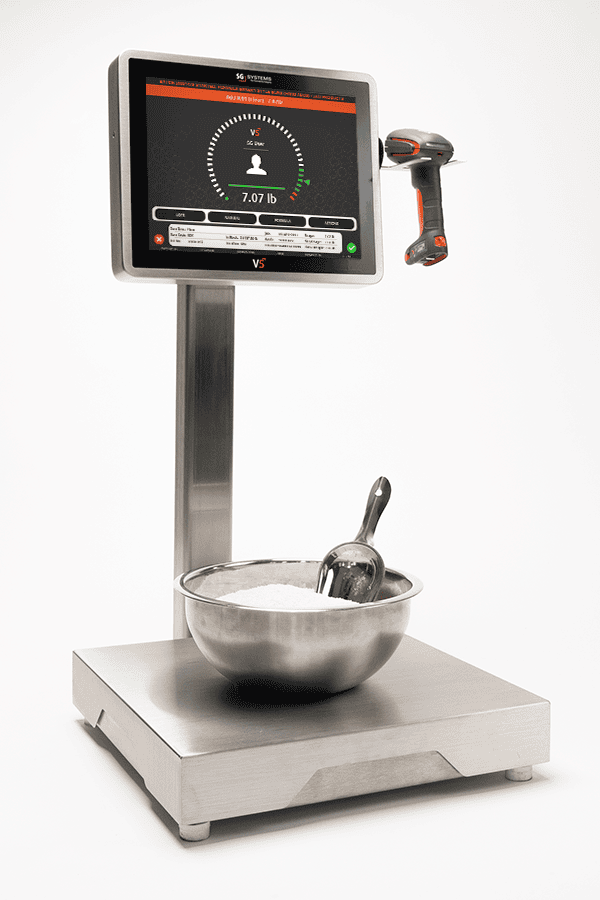
V5 Ingredient Batching orchestrates recipe weighing with identity locks, per-ingredient tolerances, allergen changeovers, scale status enforcement, and in-process labels. It feeds shop-floor evidence to V5 MES while synchronizing lots, locations, and consumption to V5 WMS. QA review and disposition sit in V5 QMS, and system-to-system exchange uses the V5 Connect API. See the V5 solution overview.
15) KPIs that prove control
- Right-first-time weighs: % of weigh steps accepted on first attempt (target >95%).
- Tolerance exceptions: exceptions per 1,000 weigh steps (trending down; explain each).
- Identity compliance: % of weigh steps with valid GS1-128 lot scans (target 100%).
- Calibration compliance: % of weigh steps executed on in-calibration scales (target 100%).
- Allergen changeover hit-rate: % of runs with completed verification before first weigh (target 100%).
- Weigh room TAT: average minutes from pick-list to last weigh complete (by formula family).
- Yield variance: absolute delta between planned vs actual ingredient totals (watch trends, not single points).
16) Common pitfalls
- “Equivalent” substitution. Operators use a different lot or ingredient without approval. Fix with scan gates and Change Control.
- Spreadsheet shadow systems. Offline sheets become the “real” record. Retire them and enforce audit trails.
- Calibration theater. Stickers with no data. Bind every weigh to an asset and block on status.
- Allergen complacency. “We always do it that way.” Document changeovers and link evidence to the batch.
- Label chaos. Word templates, wrong fields, no barcodes. Centralize label formats and print from the system.
- Uncosted variance. No one reconciles planned vs actual weights. Post consumption accurately and review the delta weekly.
17) Quick-start checklist
- Lock formulas under Document Control with alternates, tolerances, allergens, and potency factors.
- Inventory master data cleanup: GTINs, allergens, units, densities, label texts, and shelf-life rules.
- Register scales; enable calibration blocks and daily checks; validate integrations (V&V).
- Enable GS1-128 scans at pick, weigh, and point-of-use; print in-process labels.
- Publish the eBMR; train on deviations and approvals; run a mock recall trace in front of QA.
18) Extended FAQ
Q1. Ingredient Batching System vs general MES—what’s the difference?
MES orchestrates end-to-end production. An Ingredient Batching System is the precision module that governs recipe weighing: identity, tolerances, scale status, allergen changeovers, labels, and genealogy. In regulated plants, you need both—connected.
Q2. How strict should tolerances be?
By ingredient. Set asymmetric gates (e.g., +0%/−1% for nitrite, ±0.5% for enzymes, ±2% for salt). Tie any override to QA with reason codes and e-signatures. Never “round down” parts that matter.
Q3. Do we need Part 11 controls just for weighing?
If you use electronic records or signatures, yes: unique users, e-signatures, device time sync, and audit trails.
Q4. How are allergen changeovers verified?
Pre-weigh checklists, scan-verified cleaning lots or kits, photo evidence where required, and a hard gate preventing first weigh until completed.
Q5. Can we handle catch-weight and rework?
Yes—capture actual weights, lot rework with properties and limits per formula, and enforce reclaim caps. Always print new in-process labels after rework additions.
Q6. How do we integrate with ERP and WMS?
Use the V5 Connect API to exchange pick-lists, lots, consumption, and locations between V5 WMS, ERP, and the batching module.
Q7. What’s the minimum viable Ingredient Batching System?
Controlled formulas, GS1-128 scan gates, per-ingredient tolerances, scale status blocks, allergen changeover verification, in-process labels, e-sign + audit trails, and clear eBMR outputs.
Q8. Where does QA disposition happen?
After weighing and mix-add confirmations, QA reviews the eBMR and dispositions under Lot Release, linking to CoA where applicable.
Related Reading
• Foundations: MES | QMS | WMS | BMR | eBMR
• Controls: Part 11 | Annex 11 | Audit Trail | Calibration Status
• Materials & Identity: GS1-128 | FEFO | Allergen Control | Traceability
• V5 Products: Solution Overview | V5 MES | V5 QMS | V5 WMS | V5 Connect API
OUR SOLUTIONS
Three Systems. One Seamless Experience.
Explore how V5 MES, QMS, and WMS work together to digitize production, automate compliance, and track inventory — all without the paperwork.

Manufacturing Execution System (MES)
Control every batch, every step.
Direct every batch, blend, and product with live workflows, spec enforcement, deviation tracking, and batch review—no clipboards needed.
- Faster batch cycles
- Error-proof production
- Full electronic traceability

Quality Management System (QMS)
Enforce quality, not paperwork.
Capture every SOP, check, and audit with real-time compliance, deviation control, CAPA workflows, and digital signatures—no binders needed.
- 100% paperless compliance
- Instant deviation alerts
- Audit-ready, always

Warehouse Management System (WMS)
Inventory you can trust.
Track every bag, batch, and pallet with live inventory, allergen segregation, expiry control, and automated labeling—no spreadsheets.
- Full lot and expiry traceability
- FEFO/FIFO enforced
- Real-time stock accuracy
You're in great company

















How can we help you today?
We’re ready when you are.
Choose your path below — whether you're looking for a free trial, a live demo, or a customized setup, our team will guide you through every step.
Let’s get started — fill out the quick form below.