

Paperless Traceability System
Paperless Traceability System — End-to-End Lot Genealogy from Receiving to Shipment
This topic is part of the SG Systems Global regulatory & operations glossary.
Updated November 2025 • paperless traceability system, one-up/one-down, EPCIS, GS1-128, eBMR, electronic records, mock recall • Food, Dietary Supplements, Pharma, Cosmetics, Chemicals, Produce, Meat & Sausage, Bakery
A modern Paperless Traceability System provides continuous, electronic lot genealogy from the front door (raw material receiving) to the back door (finished-goods shipment). It binds every lot to suppliers, inspections, transformations, work orders, and customers without relying on paper travelers or spreadsheets. It must satisfy one-up/one-down traceability, FSMA 204 expectations, GFSI schemes, and GMP data integrity under 21 CFR Part 11 and EU Annex 11. In a recall, paperless traceability is the difference between minutes and days.
“If it takes more than a few minutes to answer which lots went where, when, and with what, you don’t have a traceability system. You have a filing cabinet and hope.”
TL;DR: A robust Paperless Traceability System tracks lots from receiving → storage → batching → processing → packaging → warehouse → shipment. It captures Key Data Elements (KDEs) at Critical Tracking Events (CTEs), enforces barcoded identity (GS1-128), integrates with MES/WMS/ERP, and produces searchable eBMR/eDHR evidence with audit trails. Trace in seconds, not days.
1) Why a Paperless Traceability System now—hard truths
- Regulators assume you can trace. FSMA, GFSI, BRCGS, SQF, and pharma GMP all expect proven lot genealogy. “We keep COAs in a folder” is not enough.
- Recalls are getting faster. Retailers and regulators expect near-real-time impact analysis. If you’re doing manual lookups, you are already behind the media cycle.
- Paper is fragile. Missing travelers, illegible handwriting, and disconnected spreadsheets create gaps that auditors and attorneys notice immediately.
- Cloud and trading partners need data, not scans. Large customers and marketplaces want structured traceability feeds (EPCIS, EDI), not PDFs of batch records.
- Data integrity applies to traceability too. Shared logins, white-outs, and back-dated entries are still common. A paperless traceability system with Part 11 controls closes the gaps.
2) Scope of a Paperless Traceability System
| Stage | What the system controls | Glossary anchors |
|---|---|---|
| Supplier & Item Master | Approved suppliers, specs, allergens, risk classification | Supplier Approval, Allergen Control |
| Receiving (Front Door) | PO match, lot/expiry, status, KDE capture at receiving CTE | Raw Material Intake, FSMA 204 |
| Storage & Movement | Locations, FEFO, quarantines, GS1-128 pallet IDs | FEFO, WMS |
| Ingredient Batching | Lot consumption links, weigh tickets, e-signatures | BMR, eBMR |
| Processing & In-Process | CTEs at mix/cook/fill/hold, rework lotting, process parameters | CCP, HACCP |
| Packaging & Labeling | Finished lot assignments, date codes, label version control | Packaging Line Verification |
| Finished-Goods Warehousing | Case/pallet IDs, loads, holds, inventory accuracy | GS1-128, Lot Release |
| Order Picking & Shipment (Back Door) | Customer order trace, ship lots, KDE capture at shipping CTE | One-Up/One-Down |
| Complaints & Recalls | Impact analysis, mock recalls, regulatory reports | Complaints, CAPA |
| Data Integrity | Audit trails, access control, record retention | Part 11, Retention |
| Integrations | MES/WMS/ERP/LIMS/EPCIS/EDI connectivity | MES, LIMS |
3) KDEs, CTEs & genealogy—record the points that matter
A real Paperless Traceability System is not a copy of your ERP with prettier screens. It is built around Key Data Elements (KDEs) at Critical Tracking Events (CTEs). For each CTE—receiving, transformation, rework, co-mingling, packing, and shipping—you define KDEs (what must be captured) and enforce them with barcodes, handhelds, terminals, and equipment integrations. The system then builds lot genealogy: which inputs went into which intermediates, which intermediates went into which finished lots, and where those lots shipped.
4) Front door control—receiving and supplier linkage
Traceability starts at the first scan:
- Supplier & PO match. Scan the supplier label or GS1-128; confirm against purchase order, spec, and approved supplier status.
- Lot, expiry, and status. Capture supplier lot, internal lot (if different), expiry, quantity, and initial status (quarantine vs released). Apply a system-generated intake label.
- Allergen and risk flags. Tag allergens, organic status, country of origin, and risk category to drive downstream controls and KDE sets.
- Sampling and QA holds. If sampling is required, link sample IDs, planned analyses, and provisional status until results support QA release.
5) Inside the walls—WMS, movement, and zoning
Once materials are through the front door, a paperless traceability system relies on WMS logic to keep track of where each lot sits and how it moves:
- Location tracking. Every move (put-away, transfer, consolidation) creates a timestamped transaction: from-location, to-location, operator, device.
- FEFO and zoning. FEFO rules drive picks for at-risk materials; zoning separates allergens, high-risk ingredients, and raw vs RTE storage.
- Pallet and container IDs. Pallets, totes, and bins receive unique IDs; internal GS1-128 labels encode lot, quantity, and location.
- Cycle counting & integrity. Regular counts validate the electronic record against reality; discrepancies generate investigations and corrections.
6) Batching & processing—where traceability meets process control
The “middle” of the plant is where things go wrong in recalls if genealogy is broken. A Paperless Traceability System integrates tightly with MES and batching:
- Lot consumption. Ingredient scans at batching and line-side ensure that actual lots consumed into each batch are recorded—not just planned lots on a work order.
- Process parameters. CCPs and critical process parameters (temperature, time, pH, pressure, lethality) are tied back to lots and work orders.
- Rework management. Rework lots are given their own IDs, characteristics, and reclaim limits by formula; genealogy captures where rework was used.
- eBMR/eDHR outputs. The result is a fully electronic eBMR or eDHR that feeds the traceability graph.
7) Packaging & finished lots—where the outside world sees your data
Packaging and labeling are the final transformation CTEs before finished goods hit the warehouse and customers:
- Finished lot creation. The system creates finished-goods lots when units roll off the line, linking them to batch/line/time windows and upstream ingredient lots.
- Date codes and traceability codes. Use controlled rules for best-before/use-by, Julian codes, and trace codes; document them in the system to support field decoding.
- Label version control. Label templates, regulatory texts, and claims are versioned under Document Control; the system logs which version printed which codes.
- Case and pallet labels. Cases and pallets receive GS1-128 or equivalent IDs encoding GTIN, lot, quantity, and date, all linked back to the traceability graph.
8) Back door control—picking, loading, and customer trace
At the back door, the traceability requirement flips: instead of “which lots went into this batch?” you must answer “which customers received this lot?” A Paperless Traceability System provides that instantly:
- Order allocation. Orders are allocated to specific lots under FEFO and business rules (certification, customer-specific requirements).
- Scan-based picking. Pickers scan case/pallet labels; the system confirms order, location, and lot; substitutions and shorts are logged, not scribbled.
- Load confirmation. Loads are sealed at the transaction level (which lots, which pallets, which truck, which route). BOLs and ASNs reflect the actual lots loaded.
- Customer trace. At any time, you can query by finished lot or inbound ingredient lot and see which customers, orders, and shipments are affected.
9) Data integrity & Part 11—electronic traceability that inspectors trust
Electronic traceability is only credible when it meets data integrity expectations:
- Unique users. No “terminal” logins; each user is accountable for their scans and confirmations.
- E-signatures where decisions are made. Lot releases, deviations, and recalls require electronic signatures under Part 11.
- Time synchronization. Devices and servers keep consistent timestamps; event order is defensible.
- Immutable audit trails. Every insert, modify, and delete event is logged with who, when, what changed, and why.
- Retention & archiving. Traceability records follow defined retention rules (retention) and survive system upgrades.
10) Mock recalls & impact analysis—prove it before it’s real
A Paperless Traceability System earns its keep during mock recalls:
- Upstream analysis. Start with a finished lot or complaint and see all contributing raw and packaging lots; identify common-mode risks.
- Downstream analysis. Start with a suspect ingredient lot and immediately list all batches, finished lots, customers, and shipments affected.
- Time-to-answer KPIs. Track how long it takes to answer recall questions and reduce the time with each drill.
- Integrated CAPA. Findings feed directly into CAPA and Change Control.
11) Implementation playbook—front door to back door in phases
- Define traceability scope and CTEs. Map your process from receiving to shipment; define which events are CTEs and which KDEs are mandatory at each step.
- Clean up master data. Align item codes, specs, GTINs, allergens, suppliers, customers, and label rules. Broken master data equals broken traceability.
- Digitize receiving and warehouse. Start where data enters the plant: handhelds at receiving, WMS for locations, pallet IDs, and FEFO.
- Integrate MES and batching. Tie lot consumption and process parameters into eBMR/eDHR; eliminate paper travelers.
- Digitize shipping and recall drills. Move to scan-based picking and loading, then run mock recalls to prove front-door-to-back-door coverage.
12) How people search for this (and what we cover)
Teams typically search for paperless traceability system, end-to-end traceability software, FSMA 204 KDEs and CTEs, one-up/one-down traceability, GS1-128 lot tracking, mock recall system, GFSI-compliant traceability, and traceability in eBMR. This page frames those concepts in practical, shop-floor terms and connects them to actual system behavior.
13) How this maps to V5 by SG Systems Global
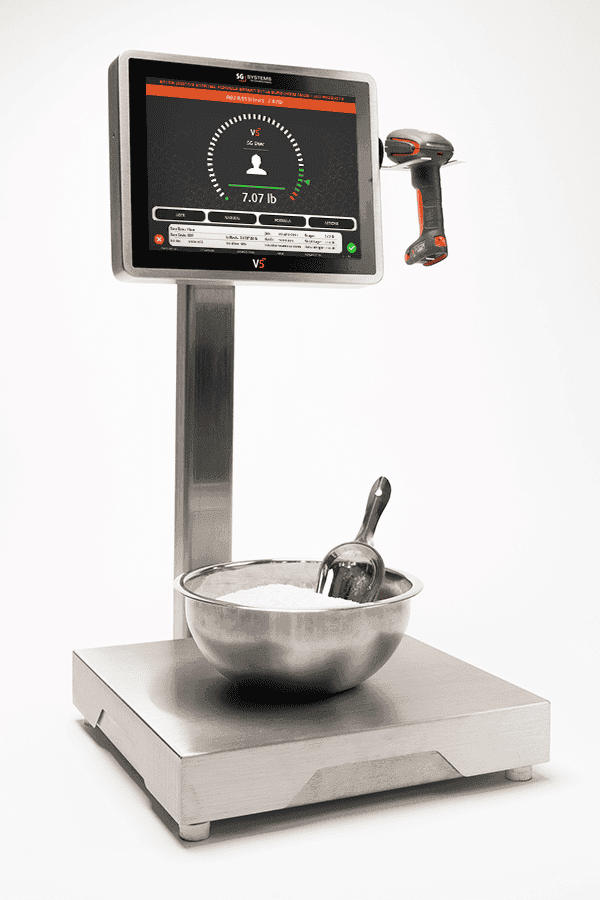
V5 Traceability acts as a Paperless Traceability System across receiving, warehouse, batching, MES, and shipping. V5 WMS captures KDEs at receiving and internal moves; V5 MES records lot consumption and process evidence into eBMR; V5 QMS manages release, CAPA, and recall workflows; V5 Connect API synchronizes data with ERP, LIMS, and trading partners. See the full V5 solution overview.
14) KPIs that prove traceability control
- Mock recall time-to-answer: minutes from recall trigger to complete impact list (target measured in minutes, not hours).
- Traceability completeness: % of lots with full upstream and downstream links across all CTEs.
- Scan compliance: % of CTEs executed with barcoded scans vs manual entries.
- Data-integrity incidents: audit-trail exceptions per 10,000 transactions; should trend down to rare, investigated cases.
- Inventory accuracy: difference between system and physical counts by lot and location.
- Release cycle time: time from batch completion to QA disposition, driven by data availability and trace clarity.
15) Common pitfalls
- Partial digitization. Receiving is electronic but internal moves or shipping remain on paper; gaps appear during recalls.
- Disconnected islands. ERP, WMS, MES, and LIMS all track lots differently. A Paperless Traceability System must harmonize IDs and events.
- Master data neglect. Wrong GTINs, allergens, or label rules undermine an otherwise solid process.
- Ignoring rework and returns. Rework, returns, and rework-intended lots often fall outside the traceability model and become blind spots.
- Audit-trail blindness. Systems have audit trails, but no one reviews them; data integrity issues remain undetected until inspection.
- No regular mock recalls. Traceability is assumed to work but never stress-tested end-to-end.
16) Quick-start checklist
- Map receiving → storage → batching → processing → packaging → warehouse → shipment, marking CTEs and KDEs.
- Standardize lot ID rules, label formats, and GS1-128 usage for raw, WIP, and finished goods.
- Deploy scan-based receiving and WMS with FEFO and zoning; retire manual receiving logs.
- Integrate batching and MES so lot consumption and process parameters roll into eBMR/eDHR.
- Digitize picking and loading; use scan-based confirmations; link loads to orders and customers.
- Schedule quarterly mock recalls and track time-to-answer and data gaps as explicit KPIs.
17) Extended FAQ
Q1. What is a Paperless Traceability System?
A Paperless Traceability System is an end-to-end digital platform that tracks lots from receiving to shipment using barcodes, terminals, MES/WMS integration, and electronic records. It replaces paper travelers, manual logs, and disconnected spreadsheets with a single, searchable genealogy.
Q2. How does this differ from basic lot tracking in ERP?
ERP usually knows planned lots and high-level inventory positions. A paperless traceability system captures actual lots at every CTE, integrates process evidence (CCPs, QA tests, eBMR), and provides recall-grade genealogy.
Q3. How does FSMA 204 affect traceability requirements?
FSMA 204 defines KDEs and CTEs for certain high-risk foods and expects fast, accurate reporting. A paperless traceability system embeds those KDEs into day-to-day operations.
Q4. Can a Paperless Traceability System be phased in?
Yes. Many sites start with receiving and warehouse, then extend to batching, processing, packaging, and shipping in defined phases.
Q5. How does this work for co-manufacturers and private label?
Co-mans often handle multiple brands and specs; a paperless traceability system ensures that each brand’s requirements, label rules, and trace codes are applied and documented correctly per job.
Q6. Which roles use the system day-to-day?
Receivers, forklift drivers, weigh room operators, line operators, lab analysts, warehouse teams, QA, planning, and supply chain all interact with the system at their respective CTEs.
Q7. Is cloud mandatory for a Paperless Traceability System?
No, but cloud or hybrid architectures often simplify integration and data sharing with customers and regulators. On-prem solutions must still meet the same data integrity expectations.
Q8. What is the minimum viable Paperless Traceability System?
Barcode-based receiving, WMS-driven locations and moves, lot-linked batching and eBMR, scan-based picking and loading, a searchable genealogy engine, and Part 11-grade audit trails.
Related Reading
• Foundations: MES | QMS | WMS | BMR | eBMR
• Traceability & Risk: One-Up/One-Down | FSMA 204 | KDE | CTE
• Data Integrity: Part 11 | Annex 11 | Audit Trail | Retention
• V5 Products: Solution Overview | V5 MES | V5 QMS | V5 WMS | V5 Connect API
OUR SOLUTIONS
Three Systems. One Seamless Experience.
Explore how V5 MES, QMS, and WMS work together to digitize production, automate compliance, and track inventory — all without the paperwork.

Manufacturing Execution (MES)
Control every batch, every step.
Direct every batch, blend, and product with live workflows, spec enforcement, deviation tracking, and batch review—no clipboards needed.
- Faster batch cycles
- Error-proof production
- Full electronic traceability

Quality Management (QMS)
Enforce quality, not paperwork.
Capture every SOP, check, and audit with real-time compliance, deviation control, CAPA workflows, and digital signatures—no binders needed.
- 100% paperless compliance
- Instant deviation alerts
- Audit-ready, always

Warehouse Management (WMS)
Inventory you can trust.
Track every bag, batch, and pallet with live inventory, allergen segregation, expiry control, and automated labeling.
- Full lot and expiry traceability
- FEFO/FIFO enforced
- Real-time stock accuracy
You're in great company

















How can we help you today?
We’re ready when you are.
Choose your path below — whether you're looking for a free trial, a live demo, or a customized setup, our team will guide you through every step.
Let’s get started — fill out the quick form below.