

Pharmaceutical Batch Record
Pharmaceutical Batch Record — Evidence That Every Batch Met GMP
This topic is part of the SG Systems Global regulatory & operations glossary.
Updated November 2025 • Pharmaceutical Batch Record, BMR/eBMR, MBR/MMR, 21 CFR 211, EU GMP, Annex 11, GAMP 5 • Sterile & Non-Sterile Pharma, Biologics, ATMPs, Contract Manufacturing
A Pharmaceutical Batch Record is the formal, traceable story of how a specific batch of drug product or active ingredient was made, tested, packaged, released and distributed. In most organisations it is called a Batch Manufacturing Record (BMR) or, in electronic form, an Electronic Batch Record (eBMR). It is the primary piece of evidence inspectors ask for under 21 CFR 211, EU GMP and related guidance.
Where the Master Manufacturing Record (MMR) or Master Batch Record (MBR) defines what should happen, the Pharmaceutical Batch Record proves what actually did happen: which lots, which equipment, which operators, which parameters, which deviations, which tests, which decisions and ultimately which disposition.
“If it isn’t in the Pharmaceutical Batch Record, regulators will assume it didn’t happen.”
TL;DR: A Pharmaceutical Batch Record (paper or eBMR) is the batch-specific execution of the MBR/MMR. It captures raw-material lots, equipment, weighed quantities, process steps and CPPs, in-process and release tests, cleaning and line clearance, deviations and CAPA, approvals and final disposition under 21 CFR 211, EU GMP, Part 11/Annex 11 and data integrity expectations. It is the cornerstone for investigations, recalls, APR/PQR and CPV in pharmaceutical manufacturing.
1) What is a Pharmaceutical Batch Record?
Regulators describe batch records in various ways, but the practical definition is consistent:
- Batch-specific realization of the master. Each batch record is an instantiated, unique copy of the approved MBR/MMR with all batch identifiers, dates and planned quantities resolved.
- Execution plus evidence. It contains both procedural steps (instructions) and the evidence that steps were followed: entries, scans, device data, calculations, signatures and attachments.
- Owned by QA. Manufacturing and QC create most of the content, but Quality typically owns the Pharmaceutical Batch Record process, review and final disposition.
A complete Pharmaceutical Batch Record is therefore both a manufacturing log and a legal document. When inspectors, sponsors or QPs want to understand a batch, this is where they start.
2) Contents of a Pharmaceutical Batch Record
| Section | What it contains | Glossary anchors |
|---|---|---|
| Header & Identification | Product name & strength, dosage form, batch/lot number, size, route, MBR/MMR version, plant, dates | BMR, MBR |
| Raw Materials & Components | List of components with quantities, units, tolerances; actual lots, quantities weighed, reconciliation | Component Lot Traceability, Batch Material Verification |
| Equipment & Line Clearance | Equipment IDs, cleaning & line clearance records, status checks, pre-use verifications | Line Clearance, Equipment Qualification IQ/OQ/PQ |
| Manufacturing Instructions | Step-by-step instructions (charge, mix, heat, cool, granulate, compress, coat, fill, etc.) | Recipe & Parameter Enforcement |
| Process Data & CPPs | Recorded process parameters (time, temp, pH, torque, pressure), setpoints, ranges, alarms | CPPs, Process Validation |
| In-Process Controls (IPC) | Sampling instructions, test methods, results, analyst & reviewer signatures, acceptance decisions | IPC, LIMS |
| Yield & Reconciliation | Theoretical vs. actual yield, scrap/rework, reconciliation of printed components & labels | Yield Variance, Mass Balance |
| Cleaning, Setup & Changeover | SIP/CIP records, cleaning logs, cross-contamination controls, changeover verification | Cleaning Validation, Cross-Contamination Control |
| Deviations & CAPA | Non-conformances, investigations, root cause, impact assessments, corrective/preventive actions | Deviation/NC, CAPA |
| QC Release Data | Analytical results (assay, impurities, micro, ID, appearance), certificates, COAs, OOS/OOT | Tests & Lab Review, Hold/Release |
| Review & Disposition | Production & QC review, QA final review, QP or authorised person decision, batch status | Batch Review by Exception (BRbE), Qualified Person (QP) Release |
3) Paper vs. Electronic Pharmaceutical Batch Records
Historically, batch records were paper binders. Today, many organisations are moving towards Electronic Batch Records (eBMR) in MES platforms, but both models still exist:
- Paper batch records. Controlled pre-printed forms, completed manually. Strengths: familiar, tangible. Weaknesses: illegible entries, missed steps, manual calculations, transcription errors and slow review.
- Hybrid records. Paper instructions with electronic attachments (e.g. equipment prints, LIMS reports). Risk: scattered data and weak data integrity.
- eBMR in MES. Instructions, data capture, interlocks, calculations and signatures implemented electronically with Part 11/Annex 11-compliant controls.
A well-designed eBMR system enforces the process (right step, right user, right device, right material, right limits) and automatically builds the Pharmaceutical Batch Record as a by-product of doing the work correctly.
4) Data integrity and Part 11/Annex 11 expectations
Because the Pharmaceutical Batch Record is primary evidence, it is a major focus of data integrity inspections. Regulators apply ALCOA+ principles (Attributable, Legible, Contemporaneous, Original, Accurate, Complete, Consistent, Enduring, Available) and expect:
- Unique users and e-signatures. No shared logins; signatures comply with 21 CFR Part 11 or Annex 11 requirements for identification, meaning and security.
- Audit trails. All changes to GMP data in the batch record—values, limits, instructions, approvals—are tracked with Audit Trail entries including who, what, when and why.
- Controlled templates. Printed forms or eBMR templates are version controlled; no user-designed spreadsheets or uncontrolled printouts for critical steps.
- Time synchronisation. Clocks in MES, LIMS and DCS/SCADA are synchronised so event order is defensible.
- Retention & archival. Batch records remain readable and intact for the full retention period under Record Retention & Archival policies.
5) Deviations, OOS/OOT and CAPA in the Pharmaceutical Batch Record
Things go wrong; a robust Pharmaceutical Batch Record makes problems visible, not hidden:
- Structured deviation capture. Process deviations, equipment alarms, out-of-tolerance CPPs, IPC failures and atypical events are recorded as Deviations/NCs linked to the batch.
- OOS/OOT handling. Lab OOS and OOT results are referenced in the batch record with investigation outcomes.
- Root cause & CAPA. Confirmed issues flow into CAPA with actions, owners and effectiveness checks; impacts on other batches are documented via lot traceability.
- Risk-based decisions. Risk assessments (e.g. PFMEA) may be referenced where deviations intersect with critical quality attributes.
Inspectors expect to see a direct, traceable link from the Pharmaceutical Batch Record to deviation and CAPA systems—no “shadow” investigations.
6) Batch review and release — from documentation to decision
Review of the Pharmaceutical Batch Record is the gate between “manufactured” and “released”:
- Production review. Manufacturing verifies that all steps were completed, entries are legible/complete and yields reconcile.
- QC review. Laboratory staff verify sample chains, calculations and transfer of results into the record.
- QA review (BRR). QA performs Batch Record Review (BRR), often using Batch Review by Exception (BRbE) where eBMRs highlight exceptions instead of forcing line-by-line review.
- QP/Authorised person decision. For EU markets, the Qualified Person (QP) uses the batch record and supporting systems to certify release; similar roles exist elsewhere.
Manufacturing traceability software should make BRR efficient without hiding issues: clear exception views, links to deviations, integrated lab data and full audit trails.
7) Pharmaceutical Batch Records in APR/PQR and Continued Process Verification
Batch records are not only for release decisions; they also feed lifecycle quality activities:
- Annual Product Review / Product Quality Review. APR/PQR summarises variability, deviations, complaints, OOS/OOT, yields and changes across batches, using batch-record data as the raw material.
- Continued Process Verification. CPV trend charts for CPPs, IPCs and CQAs pull from structured eBMR data.
- Signal detection. Patterns in Pharmaceutical Batch Records often highlight equipment, recipe or supplier issues before they turn into recalls.
8) Common pitfalls in Pharmaceutical Batch Records
- Transcription everywhere. Values copied from instruments into paper forms or spreadsheets break data integrity and create errors.
- Illegible or incomplete entries. Missing initials, dates, times, calculations or reason-for-change entries are frequent inspection findings.
- Uncontrolled attachments. Printouts taped into records without identification, version control or cross-reference.
- Disconnected systems. MES, LIMS and QMS each tell part of the story; reviewers have to manually reconcile them.
- Late or superficial BRR. Batch records pile up, and review becomes a rubber stamp instead of a real control step.
9) Implementation playbook — strengthening Pharmaceutical Batch Records
- Stabilise the master. Ensure MBRs/MMRs are complete, version-controlled and aligned with filings and process validation.
- Standardise templates. For paper or eBMR, define standard sections and fields; eliminate free-text where structured data is needed.
- Integrate instruments and systems. Connect scales, PAT tools, reactors, LIMS and WMS so data flows directly into the batch record.
- Move towards review by exception. Configure eBMR rules to highlight deviations from the MBR so QA focuses on risk, not transcription checks.
- Train and reinforce. Make expectations for entries, corrections, attachments and signatures explicit; audit periodically and feed findings into training.
10) How V5 by SG Systems Global supports the Pharmaceutical Batch Record
V5 Traceability can act as the execution backbone for Pharmaceutical Batch Records in both originator and contract manufacturing organisations:
- eBMR generation in MES. V5 MES implements the MBR as an executable recipe with device integration, acceptance rules, interlocks and automatically generated eBMR.
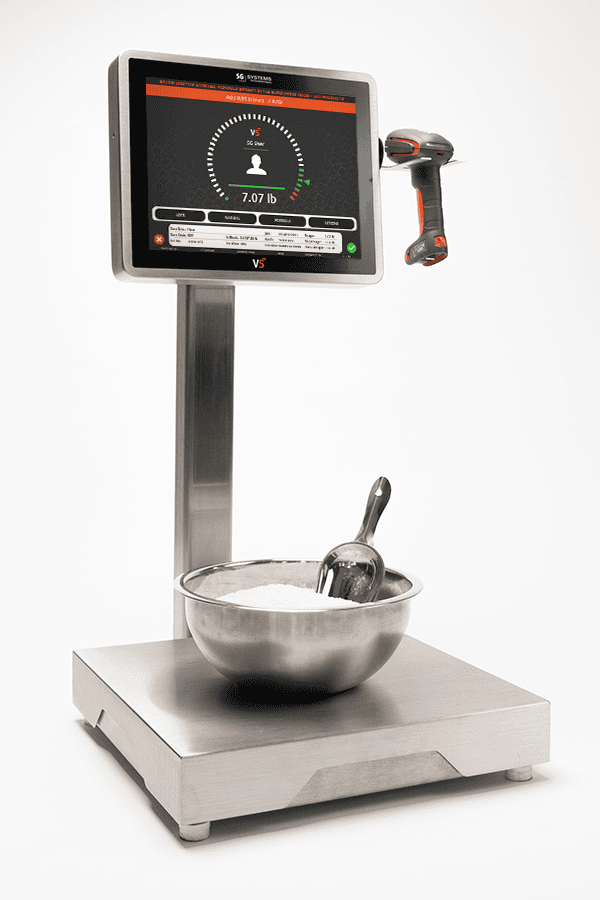
- Integrated weighing and dispensing. V5 enforces weigh & dispense automation, barcode-based material selection and tolerance control, eliminating shadow spreadsheets.
- Warehouse and distribution linkage. V5 WMS provides lot traceability from batch to bin, pallet and shipment, closing the loop for recalls and investigations.
- Quality and lab integration. V5 QMS and LIMS integration tie deviations, CAPA, test results and stability to the Pharmaceutical Batch Record.
- APIs for sponsors and CMOs. The V5 Connect API lets sponsors, CMOs and partners exchange structured batch-record data safely.
11) FAQ — Pharmaceutical Batch Record
Q1. What is the difference between a Master Batch Record and a Pharmaceutical Batch Record?
The Master Batch Record (MBR)/MMR is the approved recipe and process description for a product. The Pharmaceutical Batch Record is the batch-specific execution of that master: it shows how one particular batch followed (or deviated from) the MBR.
Q2. Is an Electronic Batch Record required?
No. Paper batch records remain acceptable if they meet GMP and data-integrity expectations. However, many companies adopt eBMR systems to reduce errors, improve review and support review by exception.
Q3. What makes a Pharmaceutical Batch Record “data-integrity compliant”?
Records must be attributable, legible, contemporaneous, original and accurate (ALCOA), with secure audit trails, unique users, controlled templates, validated systems and robust retention in line with Part 11/Annex 11 and data-integrity guidance.
Q4. How long must Pharmaceutical Batch Records be kept?
Retention periods depend on region and product type, but commonly extend for at least one year after expiry of the last batch distributed—often longer for biologics and certain products. Policies are implemented via Record Retention & Archival programs.
Q5. How does a Pharmaceutical Batch Record support recalls?
The batch record identifies which lots of raw materials, intermediates and packaging were used, and documents process conditions and test results. Combined with lot traceability, it allows you to determine which other batches may be affected and to explain why a scope is appropriate.
Q6. What is “Batch Review by Exception” and how does it relate to eBMR?
Batch Review by Exception (BRbE) is an approach where QA focuses on exceptions (deviations, atypical results, limit excursions) flagged automatically by eBMR rules, instead of re-checking every entry. It relies on high-quality, structured eBMR data and robust configuration.
Q7. Can Contract Manufacturing Organisations share Pharmaceutical Batch Records with sponsors electronically?
Yes. Many CMOs now expose controlled eBMR views or structured exports via APIs, giving sponsors visibility into execution while maintaining data integrity and access control.
Q8. What is the minimum viable Pharmaceutical Batch Record process?
At minimum: controlled MBRs/MMRs, complete and legible batch records for each batch (paper or electronic), unique user signatures, integration with lab results, documented deviations and investigations, QA review and retention for the full regulatory period.
Related Reading
• Master & Batch Records: Master Manufacturing Record (MMR) | Master Batch Record (MBR) | Batch Manufacturing Record (BMR) | Electronic Batch Record (eBMR)
• Data Integrity & Compliance: 21 CFR 211 | 21 CFR Part 11 | EU Annex 11 | GAMP 5 | Data Integrity
• Lifecycle Quality: Continued Process Verification (CPV) | Annual Product Review (APR) | PQR
OUR SOLUTIONS
Three Systems. One Seamless Experience.
Explore how V5 MES, QMS, and WMS work together to digitize production, automate compliance, and track inventory — all without the paperwork.

Manufacturing Execution (MES)
Control every batch, every step.
Direct every batch, blend, and product with live workflows, spec enforcement, deviation tracking, and batch review—no clipboards needed.
- Faster batch cycles
- Error-proof production
- Full electronic traceability

Quality Management (QMS)
Enforce quality, not paperwork.
Capture every SOP, check, and audit with real-time compliance, deviation control, CAPA workflows, and digital signatures—no binders needed.
- 100% paperless compliance
- Instant deviation alerts
- Audit-ready, always

Warehouse Management (WMS)
Inventory you can trust.
Track every bag, batch, and pallet with live inventory, allergen segregation, expiry control, and automated labeling.
- Full lot and expiry traceability
- FEFO/FIFO enforced
- Real-time stock accuracy
You're in great company

















How can we help you today?
We’re ready when you are.
Choose your path below — whether you're looking for a free trial, a live demo, or a customized setup, our team will guide you through every step.
Let’s get started — fill out the quick form below.