

Pharmaceutical Traceability Software
Pharmaceutical Traceability Software — Lot Genealogy, DSCSA & eBMR in One Spine
This topic is part of the SG Systems Global regulatory & operations glossary.
Updated November 2025 • Pharmaceutical Traceability Software, pharmaceutical traceability system, batch genealogy, DSCSA, serialisation, UDI, eBMR, warehouse & distribution traceability •
Pharmaceutical Manufacturing, Biologics, ATMPs, Contract Manufacturing
Pharmaceutical Traceability Software is the digital backbone that connects raw-material lots, in-process batches, finished units, cases, pallets and shipments into a single, searchable history. It ties together component lot traceability, batch genealogy, Electronic Batch Records (eBMR), warehouse batch-to-bin traceability, DSCSA serialisation, and, where relevant, UDI and global trade requirements.
Where your Pharmaceutical Batch Record tells the story of one batch, Pharmaceutical Traceability Software tells the story of how all your batches, lots and serials are connected: upstream to suppliers and downstream to customers, hospitals, depots and patients.
“Pharmaceutical Traceability Software is what lets you say, ‘Show me every vial, bottle or blister touched by this API lot or deviation’—and get a defensible answer in minutes.”
TL;DR: Pharmaceutical Traceability Software is a pharmaceutical traceability system that unifies component lot intake, ISA-88 batch execution, eBMR, lab results, labels and serials, warehouse batch-to-bin mapping and DSCSA/UDI events into one genealogy. It supports 21 CFR 210/211, EU GMP, Annex 11, data integrity, DSCSA, global serialisation requirements and sponsor/CMO expectations by making upstream/downstream trace simple, reliable and audit-ready.
1) What Pharmaceutical Traceability Software actually does
At a practical level, Pharmaceutical Traceability Software:
- Assigns and manages identifiers for raw-material lots, intermediates, bulk and finished goods, units, cases and pallets.
- Captures genealogy links between those identifiers across intake, weighing, manufacturing, packaging, storage and distribution.
- Pulls in context from MES, LIMS, WMS and QMS: recipes, CPPs, test results, deviations, CAPA and release decisions.
- Links genealogy to serialisation events (DSCSA, EU FMD, other markets) and, where relevant, UDI for combination products.
- Provides fast, reliable trace-back/trace-forward tools for recalls, complaints, field alerts, APR/PQR and CPV.
2) Scope of a pharmaceutical traceability system
| Area | What the software tracks | Glossary anchors |
|---|---|---|
| Component Intake | Supplier lots, COAs, sampling, status (quarantine/released), ID mapping | Component Lot Traceability, Hold/Release |
| Weigh & Dispense | Weighed quantities, scales, operators, pre-weigh kits, dispensing sequences | Weigh & Dispense Automation, Paperless Dispensing |
| Batch Genealogy | Batches produced, lots consumed, rework flows, intermediate transfers | Batch Genealogy, End-to-End Lot Genealogy |
| eBMR & Process Context | Link from genealogy to eBMR, CPPs, IPCs, deviations and approvals | eBMR, CPPs, Deviation/NC |
| Packaging & Serialisation | Packaged lots, units/serials, aggregation to case/pallet, market hierarchies | Serialization, DSCSA, UDI |
| Warehouse & Distribution | Batch-to-bin mapping, FEFO, shipments, returns, 3PL and trading-partner data | Batch-to-Bin Traceability, Returns/RMA |
| Quality, APR & CPV | Links to QC results, complaints, CAPA, APR/PQR and CPV datasets | APR/PQR, CPV, CAPA |
| Compliance & Records | Audit trails, signatures, retention, regulators’ and sponsors’ evidence requests | Data Integrity, Record Retention & Archival |
3) Component intake & supplier lot traceability
Everything in pharmaceutical traceability starts with how components arrive and are controlled:
- Lot identity at the door. Component lot traceability assigns each API, excipient, primary container, closure and printed component a unique internal lot ID tied to supplier IDs and COAs.
- Sampling and status. Sampling plans, QC results and Hold/Release decisions sit inside the same traceability model, so downstream batches always reference “released” material.
- Approved suppliers and specs. Trace software links component lots to approved suppliers and specifications under Supplier Quality Management, supporting impact analysis when a supplier or spec changes.
4) Weigh & dispense, eBMR and batch genealogy
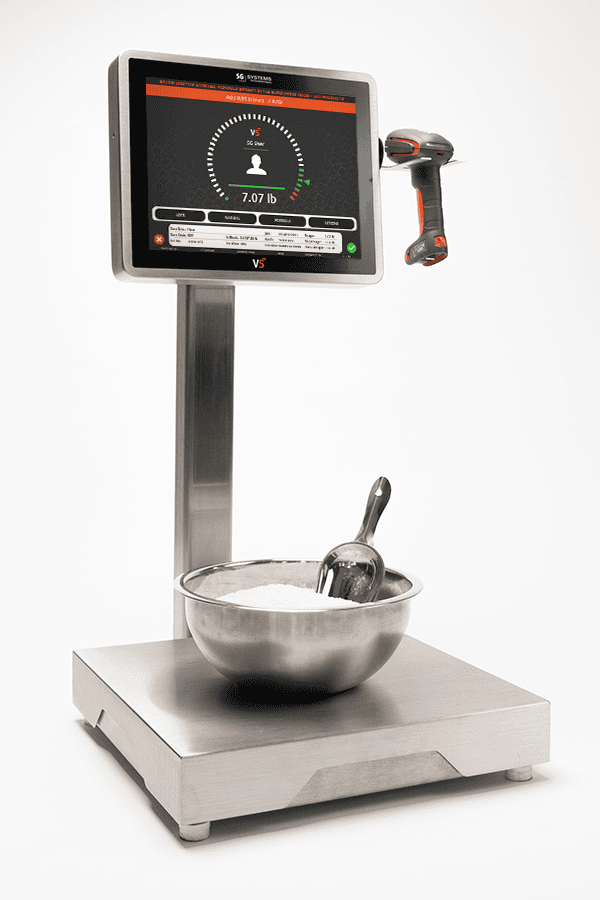
In a GMP plant, dispensed quantities are the first transformation step. Pharmaceutical Traceability Software:
- Drives weigh & dispense automation. Weigh & Dispense Automation ensures that operators scan the correct item and lot, weigh within limits and record actual weights automatically.
- Builds batch genealogy in real time. As materials are dispensed into pre-weigh kits and charged to mixers, reactors or granulators, batch genealogy links are created without additional paperwork.
- Feeds the eBMR. The same events populate the Electronic Batch Record, so lot usage and transactional traceability are two views of the same data.
- Handles rework and intermediates. When intermediates, rework or bulk are re-introduced, the system treats them as traceable components, extending genealogy rather than obscuring it.
5) Process parameters, lab results & context in genealogy
A pharmaceutical traceability system only becomes truly useful when lot genealogy is enriched with process and quality context:
- CPPs & IPCs. Critical Process Parameters (CPPs) and In-Process Controls (IPC) recorded in MES are linked to batches and their upstream lots.
- Lab results. Potency, ID, impurities, micro and other tests stored in LIMS are attached to the same genealogy, making it easy to see how particular lots or process conditions correlate with quality issues.
- Deviations and CAPA. Deviations and CAPA records are referenced by affected lots and batches, closing the loop between “what happened” and “how we responded”.
When a signal emerges in APR, PQR, complaints or pharmacovigilance, this context is what turns genealogical data into understanding.
6) Serialisation, DSCSA & UDI — extending traceability beyond the plant
Pharmaceutical Traceability Software also has to cope with unit- and case-level identifiers required by DSCSA and other serialisation regimes:
- Serialisation hierarchy. A pharmaceutical traceability system maintains links from unit serials to homogenous or mixed cases, to pallets and to shipments, using serialization hierarchies.
- DSCSA events. DSCSA transaction information and transaction history are associated with serials and lots, enabling field verification and trace-back.
- UDI for combination products. Where medical devices and pharmaceuticals intersect, UDI records become part of the same genealogical spine.
- Decommissioning & returns. Returns, destructions, sample pulls and investigation units change serial status; traceability software tracks these lifecycle events as part of the global picture.
7) Warehouse, 3PL and distribution traceability
Pharmaceutical traceability doesn’t stop at the plant gate:
- Batch-to-bin in pharma warehouses. Batch-to-Bin Traceability shows exactly which lots and pallets are in which racks, zones and temperature regimes, including controlled drugs and cold-chain products.
- 3PL integration. Where 3PLs or wholesaler depots are used, manufacturing traceability software exchanges pallet and serial data so that upstream genealogy can still be reconstructed.
- Returns and complaints. Returned lots and units are fed back into the genealogy, linked to complaint handling, RMA processes and investigations.
8) Recalls, field alerts, APR/PQR and CPV
Pharmaceutical Traceability Software earns its keep when the pressure is on:
- Recall and field alert support. From a suspect API lot, packaging component, deviation, OOS or complaint, the system must quickly show which batches, units, markets and patients may be affected.
- APR/PQR analytics. APR/PQR draw on genealogy data to analyse variability, deviations and trends across batches and campaigns.
- Continued Process Verification. CPV relies on consistent, contextualised batch data to demonstrate a state of control.
- Sponsor and CMO transparency. For contract manufacturing, sponsors increasingly expect direct visibility into traceability data; well-structured software makes it possible without spreadsheets.
9) How V5 Traceability operates as Pharmaceutical Traceability Software
V5 Traceability from SG Systems Global can serve as the execution and warehouse spine for Pharmaceutical Traceability Software in originator and CMO environments:
- On the shop floor. V5 MES controls weigh & dispense, recipe enforcement, device integration and eBMR, building batch genealogy and lot traceability by design.
- In the warehouse. V5 WMS delivers batch-to-bin tracking, FEFO and integration with external warehouses and wholesalers.
- In quality and lab. V5 QMS and the V5 QMS – LIMS Integration tie deviations, CAPA, investigations, micro and stability studies directly to lots and batches.
- Through integration. The V5 Connect API connects ERP, serialisation/DSCSA hubs, sponsor systems and regulatory-reporting tools to the same genealogy spine.
10) KPIs that show Pharmaceutical Traceability Software is working
- Genealogy completeness: % of released batches with full upstream/downstream lot and serial links (target 100%).
- Recall/field-alert response time: time from trigger to complete trace-back/trace-forward list and impact assessment.
- Mass-balance closure: % of batches/recall scenarios where material in vs. material out reconciles within defined tolerance.
- Data integrity incidents: number of inspection findings or internal issues involving missing, inconsistent or unverifiable traceability data.
- Manual reconciliation rate: proportion of investigations that still require spreadsheets to reconcile MES, LIMS and WMS data (should trend towards zero).
11) Common pitfalls in pharmaceutical traceability
- Local lot coding schemes. Different plants, CMOs or systems assign incompatible lot IDs, forcing manual mapping.
- Shadow Excel genealogies. Critical traceability relationships live in offline spreadsheets instead of in validated systems.
- Incomplete integration. MES, LIMS, WMS and serialisation hubs are not harmonised, leading to conflicting views of which units belong to which batches.
- Untracked rework and bulk splits. Rework and bulk transfers are not modelled properly, breaking batch genealogy.
- Traceability only tested during crises. No regular mock recalls or trace drills; the system is first fully exercised in a real inspection or recall.
12) FAQ — Pharmaceutical Traceability Software
Q1. What is Pharmaceutical Traceability Software?
Pharmaceutical Traceability Software is a specialised manufacturing traceability system that captures and links component lots, batches, eBMRs, lab results, serials, warehouse locations and shipments across pharmaceutical manufacturing and distribution, supporting recalls, investigations and regulatory expectations.
Q2. How is Pharmaceutical Traceability Software different from an eBMR system?
An eBMR system focuses on one batch at a time—how instructions were executed and documented. Pharmaceutical Traceability Software sees across batches and sites, connecting multiple eBMRs, components, serials and shipments into a global genealogy.
Q3. Do I still need serialisation solutions if I have a pharmaceutical traceability system?
Yes. Serialisation (DSCSA, EU FMD, UDI) handles identifiers and regulatory messaging at unit/case/pallet level. Pharmaceutical Traceability Software consumes and links serial data to batch and lot genealogy, providing the context serialisation tools do not hold alone.
Q4. Can a pharmaceutical traceability system work across multiple CMOs and sites?
It should. Modern systems, especially when combined with integration layers and standard ID schemas, can unify genealogy across originator plants, contract manufacturers, packagers and warehouses.
Q5. What is the minimum viable Pharmaceutical Traceability Software deployment?
At minimum: central control of component and batch IDs; scan-based lot usage in weigh & dispense; batch genealogy across key process steps; basic batch-to-bin in warehouses; linkage to eBMR and lab results; and a practical recall/trace tool that can answer trace-back/trace-forward questions in hours, not days.
Q6. How does Pharmaceutical Traceability Software support APR/PQR?
By consolidating batch, deviation, CAPA, lab and complaint data across campaigns, it provides the dataset needed for Annual Product Review/Product Quality Review and supports cross-batch trend analysis.
Q7. Is Pharmaceutical Traceability Software only for large pharma?
No. Smaller manufacturers, including CMOs and niche biologics or ATMP producers, also benefit: when margins are tight and regulatory risk is high, precise traceability and quick, targeted responses can be the difference between a controlled event and a business-threatening one.
Q8. How should we evaluate Pharmaceutical Traceability Software?
Focus on its ability to integrate with existing MES, LIMS, WMS, ERP and serialisation; to handle your real process flows (including rework and intermediates); to generate fast, accurate trace-back/trace-forward reports; and to support your regulatory and sponsor expectations across all your sites.
Related Reading
• Pharma Manufacturing & Records: Pharmaceutical Manufacturing | Batch Manufacturing Record (BMR) | Electronic Batch Record (eBMR)
• Traceability & Compliance: End-to-End Lot Genealogy | DSCSA | UDI | Data Integrity
• Lifecycle Quality: APR/PQR | Continued Process Verification (CPV)
OUR SOLUTIONS
Three Systems. One Seamless Experience.
Explore how V5 MES, QMS, and WMS work together to digitize production, automate compliance, and track inventory — all without the paperwork.

Manufacturing Execution (MES)
Control every batch, every step.
Direct every batch, blend, and product with live workflows, spec enforcement, deviation tracking, and batch review—no clipboards needed.
- Faster batch cycles
- Error-proof production
- Full electronic traceability

Quality Management (QMS)
Enforce quality, not paperwork.
Capture every SOP, check, and audit with real-time compliance, deviation control, CAPA workflows, and digital signatures—no binders needed.
- 100% paperless compliance
- Instant deviation alerts
- Audit-ready, always

Warehouse Management (WMS)
Inventory you can trust.
Track every bag, batch, and pallet with live inventory, allergen segregation, expiry control, and automated labeling.
- Full lot and expiry traceability
- FEFO/FIFO enforced
- Real-time stock accuracy
You're in great company

















How can we help you today?
We’re ready when you are.
Choose your path below — whether you're looking for a free trial, a live demo, or a customized setup, our team will guide you through every step.
Let’s get started — fill out the quick form below.