

Recipe Weighing System UK
Recipe Weighing System (UK) — Calibrated Scales, Tolerances & Allergen Control for British Manufacturers
This topic is part of the SG Systems Global regulatory & operations glossary.
Updated November 2025 • recipe weighing system UK, internal recipe weighing, calibrated scales, BRCGS, allergen control, GS1-128, eBMR, data integrity • UK Food & Drink, Bakery, Sausage & Meat, Ready Meals, Dietary Supplements, Cosmetics, Ingredients & Dry Mixes
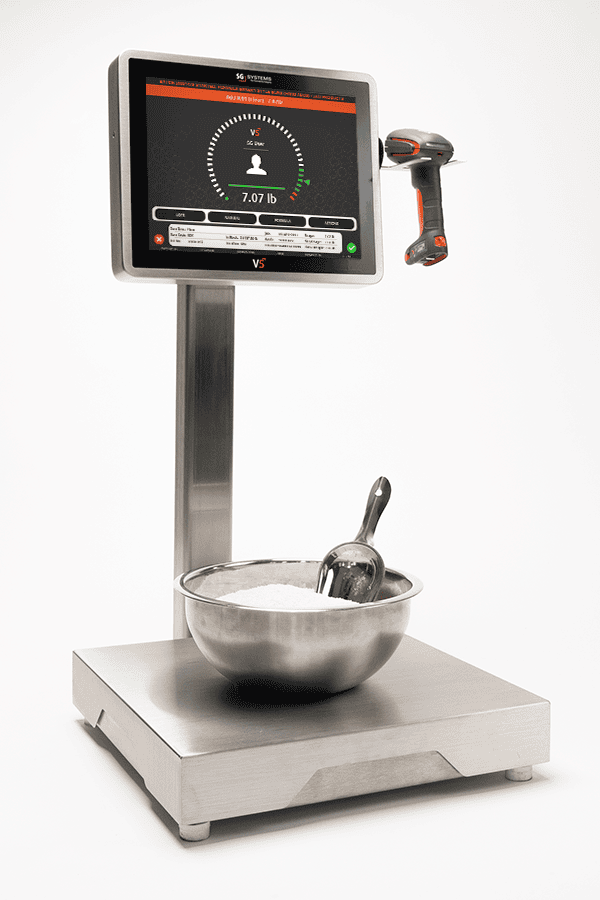
A UK-focused Recipe Weighing System is the combination of calibrated weighing equipment, barcode identity and recipe-aware software used to control ingredient additions inside British factories. It enforces the correct product, ingredient, lot, target and tolerance at the point of weigh, while recording who did what, where and when in a way that stands up to BRCGS/SALSA audits, UK retailer codes of practice and customer expectations.
For internal recipe weighing (formulation, batching, ingredient prep), the emphasis is on fitness for purpose, calibration and data integrity—not on trade approval. Legal-for-trade (approved) scales are only required where the weighing operation is used directly “for trade” (for example, pack weights sold by weight). For pure internal batching, good calibration and control are what matter.
“If your recipe weighing can’t prove which ingredient, which lot, which target, which actual, which operator, which scale—without digging—then it isn’t under control. It’s just numbers on a display.”
TL;DR: A Recipe Weighing System (UK) ties together:
- Calibrated, fit-for-purpose scales for internal batching (trade approval only where you actually sell by weight).
- Barcode or GS1-128 identity for ingredients, lots and jobs.
- Per-ingredient targets and tolerances with “approach from below” logic.
- Allergen zoning and changeover checks aligned with BRCGS, retailer codes and Natasha’s Law context.
- Full audit trails and batch records that feed BMR/eBMR, inventory and traceability.
The result: every internal weigh step is technically correct, repeatable and fully traceable from recipe to finished product, even if the scale is not a “for trade” instrument.
1) Why a UK-specific Recipe Weighing System—hard truths
- UK audits look hard at the weigh room. BRCGS, SALSA and retailer auditors routinely ask, “How do you make sure the right ingredient and amount go in every time?” A recipe weighing system is the honest answer.
- Allergens & Natasha’s Law. Mis-weighed or mis-identified ingredients can cascade into incorrect allergen declarations, a major risk in the UK since Natasha’s Law raised expectations for PPDS and prepacked foods.
- Spreadsheets don’t scale. Excel files taped to the wall and hand-written tickets are fragile; one misread number or missing sheet can undermine an entire batch record.
- Energy and labour costs demand tighter control. Habitual overshoot and “extra for luck” are direct hits to your gross margin, especially with UK energy and labour cost levels.
- Multi-site and co-manufacturing need consistency. The same product run in different UK sites or co-mans must follow the same recipe and tolerance rules; you can’t rely on local memory.
2) Scope of a Recipe Weighing System (UK)
| Area | What it controls | Glossary anchors |
|---|---|---|
| Recipe & Targets | Ingredient list, targets, units, tolerances per SKU and batch size | Products & Formulas, BOM |
| Ingredient Identity | Barcode scans for item, lot, expiry, QA status and allergen profile | Barcode Validation, GS1-128 |
| Scale Assets & Calibration | Scale IDs, ranges, calibration & verification status, fitness for purpose | Asset Calibration Status |
| Weighing Workflow | Order-of-addition, tare, stability checks, unit switching, prompts | Weigh & Dispense Automation |
| Tolerances & Interlocks | Per-ingredient tolerance bands, hard stops, QA override routing | Hard Gating, Control Limits (SPC) |
| Allergen & Zoning | Allergen tagging, line/room zoning, changeover prompts & checks | Allergen Control Program |
| Batch Records & Traceability | Per-batch weigh logs, lot usage, links to BMR/eBMR and inventory | BMR, Lot Traceability |
| Data Integrity & Audit | Users, roles, e-signatures (where applicable), audit trails, retention | Data Integrity, Audit Trail (GxP) |
| Integrations | Links to ERP/QuickBooks, MES, WMS, LIMS, label systems | MES, WMS |
3) Scales & calibration—fit for purpose vs “for trade”
For an internal recipe weighing system UK, the most important questions are:
- Is the scale fit for purpose? Does it have the right capacity and resolution for your smallest and largest additions? Can operators use it safely and repeatably?
- Is it calibrated and verified? Calibration status and routine checks must be scheduled, recorded and enforced; the system should block or warn when calibration is overdue or a verification fails.
- Is it used for trade or purely internal? If the same scale is used for price-by-weight or declared legal net weight, it should be appropriately approved and verified. If it is only used for internal recipe weighing, trade approval is typically not required—but calibration and control still are.
In short: every recipe scale must be controlled and trusted; some of them, where used for trade, must also be “legal-for-trade” compliant.
4) Ingredient identity & barcode control at the weigh station
The recipe weighing system makes sure you weigh the right ingredient from the right lot:
- Scan first, weigh second. Operators must scan the ingredient label before the scale will accept a weigh. The system checks item, lot, expiry and QA status, and ties usage back to component lot traceability.
- GS1-128 or internal codes. For higher-maturity sites, ingredients arrive with GS1-128 barcodes; at minimum, internal labels are generated at goods-in.
- Integration with WMS. The weighing system “expects” the lot that WMS staged for the job; mismatches trigger interlocks or deviation workflows.
5) Weighing workflow, tolerances & interlocks
A robust UK recipe weighing system enforces consistent operator behaviour:
- Stepwise instructions. Each ingredient is presented in order, with target and tolerance; operators can’t jump ahead or skip steps unnoticed.
- Per-ingredient tolerances. Tolerances are defined per ingredient, not per batch: ±0.5% for enzymes, +0%/−1% for nitrite, ±2% for salt, etc.
- Approach-from-below guidance. The UI helps operators creep up to target instead of overshooting and “calling it good.”
- Tare & stability. Tare is captured and stored; net weights are only recorded when the signal is stable for a defined period.
- Blocking and exceptions. Out-of-tolerance nets, expired lots or wrong items trigger hard blocks until a supervisor or QA resolves them with an e-signature and reason code.
6) Allergens & zoning in UK recipe weighing
Allergen management in the UK goes beyond labels; it starts at the weigh room:
- Allergen-tagged ingredients and recipes. Ingredients are tagged with allergen profiles; recipes aggregate these to determine risk for each run.
- Line and room zoning. The system knows which rooms/lines handle nuts, sesame, gluten-free, etc., and can restrict where specific recipes may be weighed.
- Changeover checks. For allergen transitions, cleaning and inspection steps are enforced before the first weigh of the new product, with records attached to the batch.
7) Batch records, traceability & UK audit expectations
Weighing data is a core part of your batch record and traceability story:
- Per-batch weigh history. For each batch, the system stores: ingredient, lot, net weight, operator, scale ID and timestamp.
- Integration with eBMR. Execution data flows into electronic batch records, demonstrating control of recipe and materials for UK/EU GMP or GFSI audits.
- Support for mock recalls. When asked to show where an ingredient lot was used, or which lots went to which customers, you can answer using traceability and weighing data—not guesswork.
8) Data integrity—trusted recipe weighing data
Regardless of trade approval, recipe weighing systems UK must produce data that can be trusted:
- Unique users. No generic “weighing” accounts; all entries and exceptions are attributable.
- Audit trails. Changes, overrides, re-weighs and corrections are logged with who/what/when/why.
- Retention. Records are kept as long as required for BRCGS, SALSA, retailer programmes or GMP regulations, and remain readable and retrievable.
9) How V5 delivers a Recipe Weighing System for UK manufacturers
V5 Traceability implements a recipe weighing system that fits UK operations:
- Guided weigh & dispense in V5 MES. V5 MES provides step-by-step weighing workflows per recipe and batch, with per-ingredient targets, tolerances and order-of-addition logic.
- Scale integration and calibration checks. V5 integrates with existing scales (trade-approved where needed, standard where internal) and enforces calibration/verification rules before allowing critical weighs.
- Barcode and lot validation. V5 validates ingredient identity and lot against V5 WMS allocations and QA status before any weigh is accepted.
- Allergen-aware recipes and zones. Allergen tags, zones and changeover checklists are part of the standard setup, aligned with UK retailer and BRCGS expectations.
- Traceable batch records and inventory. Weigh data feeds into batch records and inventory, supporting traceability, costing and recall readiness.
10) KPIs for a Recipe Weighing System (UK)
- Right-first-time weighs: % of weighs accepted without exception or re-weigh.
- Weighing exceptions: count of out-of-tolerance or wrong-lot events per 1,000 weighs.
- Calibration compliance: % of critical weighs executed on in-calibration scales.
- Allergen changeover completion: % of allergen-sensitive runs with documented changeover checks before first weigh.
- Mock recall time: minutes to identify all batches and customers affected by an ingredient lot from system data.
- Overfill / overshoot trend: average overshoot vs target per ingredient, trending down as operators follow “approach from below” guidance.
11) Common pitfalls in UK recipe weighing
- Assuming only legal-for-trade scales matter. Internal batching scales may not need trade approval, but they still need calibration, suitability and control.
- Letting operators pick ingredients by memory. No barcode checks, no lot validation and no enforced tolerances.
- Isolated scale displays. Weights live and die on the scale indicator; nothing flows into batch records, inventory or traceability.
- Weak allergen controls at the bench. Allergen rules exist on paper, but the system doesn’t know or enforce them.
- Unlinked labels. Pack labels and claims evolve separately from weighed recipes, creating mismatch risk.
12) Quick-start checklist for a Recipe Weighing System UK
- Identify critical recipes and ingredients where mis-weighs or allergen mistakes hurt the most.
- Inventory your current scales: capacity, resolution, calibration status and where, if anywhere, trade approval is actually required.
- Bring recipes under version control with per-ingredient targets and tolerances.
- Implement barcode-based identity checks and guided weighing on one pilot line using V5 or similar.
- Run a UK-style audit drill: show an auditor the full weigh history for a batch and trace an ingredient lot into finished product using only system data.
13) FAQ — Recipe Weighing System UK
Q1. Do we need legal-for-trade scales for recipe weighing in the UK?
Not by default. For internal recipe weighing, you primarily need fit-for-purpose, calibrated scales under your QMS/HACCP regime. Legal-for-trade approval only becomes mandatory where the weighing is directly used “for trade” (e.g. customer-facing pack weights or price-by-weight transactions). Many plants use a mix: trade-approved scales on packing/checkweighing, standard calibrated scales for internal batching.
Q2. What makes a good recipe weighing system in a UK factory?
Clear recipes with per-ingredient targets and tolerances, scanned ingredient identity, controlled scales with calibration checks, hard stops on wrong lots or out-of-bounds weights, allergen-aware zoning, and full audit trails feeding batch records and traceability.
Q3. Can a UK recipe weighing system integrate with QuickBooks or other SME finance systems?
Yes. Finance systems keep handling POs, SOs and the ledger; the recipe weighing system and associated MES/WMS handle identity, weighing and inventory on the shop floor, then push summarised movements back to the finance layer.
Q4. How does a recipe weighing system support BRCGS or SALSA certification?
By providing evidence that ingredients are positively identified, weighed within defined tolerances, used in the correct sequence and recorded reliably, and that allergen and status controls are enforced at the point of use—exactly the sort of control BRCGS and SALSA auditors expect to see.
Q5. What is the minimum viable Recipe Weighing System for a UK SME?
At minimum: calibrated scales appropriate to the job; barcode-based ingredient identity checks; controlled, versioned recipes with per-ingredient tolerances; basic per-batch weigh logs; and links to inventory and label systems so you can defend your practices during audits and investigations.
Related Reading
• Weighing & Batching: Weigh & Dispense Automation | Batch Weighing | Gravimetric Weighing
• Traceability & Quality: Lot Traceability | Allergen Control Program | BRCGS Traceability
• Systems & V5: V5 Solution Overview | V5 MES | V5 WMS | V5 QMS | V5 Connect API
OUR SOLUTIONS
Three Systems. One Seamless Experience.
Explore how V5 MES, QMS, and WMS work together to digitize production, automate compliance, and track inventory — all without the paperwork.

Manufacturing Execution System (MES)
Control every batch, every step.
Direct every batch, blend, and product with live workflows, spec enforcement, deviation tracking, and batch review—no clipboards needed.
- Faster batch cycles
- Error-proof production
- Full electronic traceability

Quality Management System (QMS)
Enforce quality, not paperwork.
Capture every SOP, check, and audit with real-time compliance, deviation control, CAPA workflows, and digital signatures—no binders needed.
- 100% paperless compliance
- Instant deviation alerts
- Audit-ready, always

Warehouse Management System (WMS)
Inventory you can trust.
Track every bag, batch, and pallet with live inventory, allergen segregation, expiry control, and automated labeling—no spreadsheets.
- Full lot and expiry traceability
- FEFO/FIFO enforced
- Real-time stock accuracy
You're in great company

















How can we help you today?
We’re ready when you are.
Choose your path below — whether you're looking for a free trial, a live demo, or a customized setup, our team will guide you through every step.
Let’s get started — fill out the quick form below.